










































Overcoming Vaccine Deployment Challenges among the Hardest to Reach: Lessons from Polio Elimination in India
University of Toronto
"[I]t is...key to understand resistant groups' justifications for not taking the vaccine and speak to their own framework of understanding....[P]ublic health authorities should acknowledge that promoting vaccines through actors that the public perceives as trustworthy is essential in improving vaccine uptake."
A key challenge to polio elimination in the final years before India was certified polio free in 2014 was resistance from vaccine-hesitant groups. In Uttar Pradesh, for example, opposition to vaccine uptake developed through a history of mistrust between the government and segments of its vulnerable populations, such as migrant workers, religious-minority Muslims, and impoverished communities. To target pockets of reduced vaccine uptake among these hard-to-reach groups, in 2002, the Social Mobilisation Network (SMNet) was formed. This article describes the management strategies that allowed local community-level actors, governmental departments, and external organisations to work together to the overcome the vaccine hesitancy that is often linked to social and economic inequalities in India.
The research team interviewed individuals in India that were involved in implementing or analysing the polio vaccination programme, including former members of the Indian Expert Advisory Group (IEAG), the United Nations Children's Fund (UNICEF), the CORE Group, Rotary International, and the World Health Organization (WHO), as well as researchers from local academic institutions such as Aligarh Muslim University (AMU).
The conversations revealed that vaccine hesitancy among vulnerable groups in India was indicative of the mistrust that healthcare-deficient communities have towards nonessential government interventions. When discussing healthcare services in urban slums, one interviewee said, "it's not a matter of hard-to-reach but rather, hardly reached." Communities felt ignored by their government, and were thus mistrusting and sceptical of government or non-governmental organisation (NGO) intervention during polio vaccination rounds. Vulnerable communities did not resist public health needs they considered more urgent, such as maternal health; vaccines, on the other hand, are less pressing and offer no immediately observable clinical benefit.
Thus, starting in 2008, a conscious change was made to market the polio vaccine initiative as a genuine healthcare-oriented programme. The polio campaign pivoted to horizontal health services, an approach taken by regional health centres, where additional medical services or medications were bundled with polio vaccines. As noted here, the bundled services should address the community's most basic needs, as defined by the community itself. Conversely, scepticism towards a vaccine by the mainstream population who already have essential social services coverage would require different strategies.
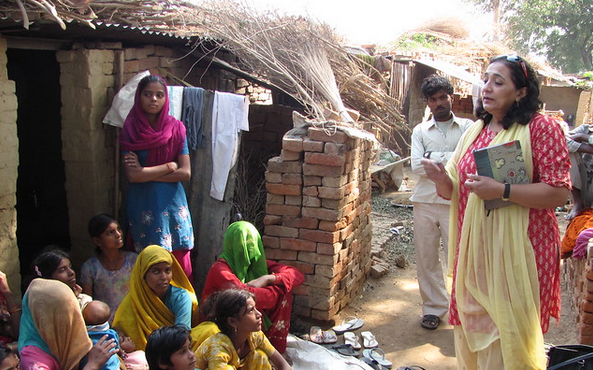
Interviewees explained that, by listening to the community's worries and providing a solution, the public health intervention can gain legitimacy. Academic institutions mobilised students to engage with underserved households individually to build trust in the polio vaccine. For example, social work students invited hesitant households for coffee or tea to build rapport. This personalised outreach by students humanised the initiative by providing individuals with an outlet to voice their concerns about the vaccine.
The research highlighted the power of local stakeholder engagement to address in-group vaccine hesitancy. While national polio media campaigns led by Indian celebrities were a contributing factor towards overcoming vaccine hesitancy in the general population, it was the local stakeholders who were found to have led to the success of the programme among the hardest-to-reach populations. Organisations involved in polio elimination observed preexisting social structures and identified key actors that could improve the efficiency of the vaccination effort:
- Employers of migrant workers: SMNet representatives contacted employers through a letter from the district official. Employers then set up vaccination booths at the work site (factory, brick kiln, construction site, tea farm), allowing new migrants entering the community to be vaccinated promptly.
- Private healthcare providers: To improve detection of acute flaccid paralysis (AFP) cases, WHO developed a community-level surveillance network in partnership with local private physicians and faith healers without formal medical training. These efforts reduced the need for external surveillance officers in vaccine-hesitant communities.
- Local media outlets: "The CORE Group produced tailored material for targeted communication campaigns, mostly directed towards mothers of households. The messaging was simple and often published in local newspapers to avoid appearing foreign. The CORE Group and UNICEF also worked with local journalists to encourage the publication of articles tackling vaccine hesitancy from well-respected journalists in the community to facilitate a dialogue on the safety and importance of the polio vaccine."
- Religious leaders: SMNet worked with Muslim universities such as AMU and Jamia Millia Islamia University (JMI), the latter of which created a "Green Book" that compiled the religious reasoning behind the duty to protect children. This book was used as a tool to help educate readers and promote polio vaccination. In addition, Rotary International formed an Ulama Committee consisting of six prominent Islamic scholars. The committee held events where Imams cited verses from the Quran that preach a parent's responsibility to take care of the health and well-being of their child. "Engagement with local students, alumni, prominent religious scholars and references to Islamic literature played important roles in tackling vaccine hesitancy and ultimately improving vaccine deployment in many Muslim communities."
A key lesson to emerge on the strategy of engaging local stakeholders is that, in India, "[g]overnment officials tapped into pre-existing social structures to identify key stakeholders with pre-existing credibility with vulnerable groups. These local leaders provided feedback to the government and became advocates for the vulnerable communities that they represented. For future vaccination efforts, this suggests that the advocacy of vaccine uptake is more effective when it comes from ingroup members."
The research also underscored the value of accountability mechanisms in the context of a public health crisis. In collaboration with WHO, SMNet, and other external stakeholders, the Indian government developed accountability and quality improvement mechanisms to ensure that the polio programme was implemented effectively. For example, workers who falsified information were made to redo training or repeat entire rounds of house-to-house microplanning. As noted here, the Indian government's strong central leadership was a major factor that led to widespread commitment by ground-level actors, yet the pressure associated with achieving positive outcomes may have also contributed to a climate of data falsification by local officials. Future public health initiatives might consider triangulating data and including smaller organisations in reporting and data collection. This framework can also allow vulnerable communities to hold their public health officials and community health workers accountable.
"India's commitment to the elimination of polio also presented an opportunity to address critical inequalities among certain vulnerable populations by engaging with local stakeholders. This is not a phenomenon isolated to India, and by understanding how to overcome these barriers, future epidemics can be controlled in a more efficient manner."
BMJ Global Health 2021;6:e005125. doi:10.1136/bmjgh-2021-005125. Image caption/credit: Social mobiliser providing education about polio vaccination to mothers and children, India - CDC Global
- Log in to post comments