










































Lessons from the Elimination of Poliomyelitis in Africa
Africa Centres for Disease Control and Prevention, or CDC (Mohammed, Nkengasong); Redeemer's University (Tomori)
"With the benefit of hindsight,...the GPEI should have made community mobilization and participation one of the main strategic pillars of polio eradication at the onset, much like the immunization and surveillance strategies."
In August 2020, Africa was declared free of wild poliovirus (WPV) after a 32-year effort. This article chronicles the global, continental, national, and community actions taken by diverse stakeholders that led to this achievement. It discusses the challenges encountered, particularly in Nigeria, exploring the lessons learned and their potential applicability to future public health interventions in Africa and elsewhere. This summary focuses on the communication elements of the experience.
The cascade of events started with the development of polio vaccines and the realisation that polio, much like smallpox, could be eradicated. The Global Polio Eradication Initiative (GPEI) was built on lessons learned from earlier efforts to control polio in North America, Cuba, Brazil, and some European countries, with strategic adjustments to meet the specific challenges facing many African and Asian countries. Activities included evidence-based approaches for the harmonisation and standardisation of public health strategies, use of a network of polio laboratories and emergency operation centres (EOCs), and active pursuit of underserved populations.
By the turn of the century, the only country in the African region that remained endemic for WPV was Nigeria, where a disagreement in 2003 over the safety of oral polio vaccine (OPV) led some religious leaders to openly preach against the use of OPV and, ultimately, to some states placing a total ban on the use of the vaccine. Within a short time, the reported number of laboratory-confirmed polio cases in Nigeria quadrupled, and between 2002 and 2011, WPV imports, primarily from Nigeria, led to the reestablishment of WPV transmission and outbreaks in 39 countries that had previously been certified polio-free.
Historically in northern Nigeria, WPV transmission was largely due to a combination of socio-economic determinants of health, which was complicated by community resistance to immunisation services. Thus, in response, the GPEI carried out concerted efforts to gain the trust of the state governments and communities across northern Nigeria and to recruit influential traditional and religious leaders as champions for the polio elimination activities. The United Nations Children's Fund (UNICEF) and partners supported thousands of voluntary community mobilisers in northern states of Nigeria, whose work included, for example, engagement of community influencers to ensure community buy-in. As a result, hundreds of thousands of households reversed their decision to refuse vaccination.
Almost from the onset of the GPEI until the time Africa became certified as polio-free, regional conflicts were a reoccurring challenge. Among the strategies pursued: the delivery of vaccines to the at-risk population by health teams that consisted of personnel from within the community, shorter periods of intervention from outside experts, engagement of security personnel, and vaccination campaigns at border crossing points. The latter effort is related to another challenge, that of reaching mobile populations: In Nigeria, of the 112 cases of WPV infection with a date of onset in 2012, 80% were found within or close to underserved populations of nomadic pastoralists.
Looking ahead, with an eye to safeguarding Africans' health security, the Africa CDC is supporting national public health institutions across African Union member states to create strong institutions that can coordinate core public health functions of surveillance, laboratory networking, workforce development, and management of EOCs. In the latter vein, "[T]he polio EOC eventually impacted on the polio programme in Nigeria by ensuring that data-driven policies were used for real-time decision-making and by strengthening both national and partner accountability. At the onset of the 2014 Ebola virus disease (EVD) outbreak in Nigeria, the polio EOC structure had been operational for more than 2 years. Three days after the first case of EVD had been confirmed in Nigeria, the polio EOC quickly transformed into an EVD EOC...Nigeria continues to use a multihazard EOC, now situated within the Nigeria Centre for Disease Control, for the response to subsequent public health events, including the COVID-19 pandemic."
In conclusion: "The importance of stakeholder engagement and ensuring community mobilization as well as creativity to surmount challenges such as vaccination campaigns for nomadic underserved communities as well as in conflict zones are important lessons learnt from the African experience."
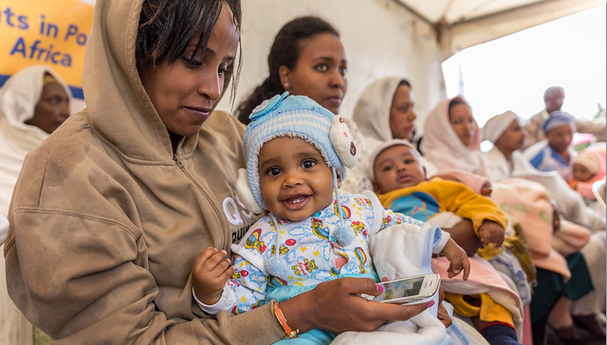
Nature Reviews Immunology (2021). https://doi.org/10.1038/s41577-021-00640-w. Image caption/credit: Emebet Felke waiting to vaccinate her child against polio at Selam Health Center, Gulele Sub city, Addis Ababa, Ethiopia. Credit: Mulugeta Ayene UNICEF via Flickr (CC BY-NC-ND 2.0)
- Log in to post comments