










































Perspectives on Rapid Elimination and Ultimate Global Eradication of Paralytic Poliomyelitis Caused by Polioviruses
"[I]t is necessary for Ministries of Health in poor countries to learn how to organize nonprofessional, often illiterate people, into disciplined, coordinated groups for self-help in many health matters...not only for the eradication of polio, but also for the rapid elimination of...other vaccine preventable diseases..."
This article was written by the developer of the oral poliovirus vaccine (OPV), Albert Bruce Sabin, MD, at age 84, two years before his death. In it, he provides his perspectives on issues involved in the eradication of paralytic poliomyelitis caused by polioviruses in different parts of the world and the changes in immunisation strategy that, in his judgment, are needed if the goal for global eradication in the next 10 years is to be approached. He suggests that progress toward eradication of "wild" polioviruses from economically poor tropical and subtropical countries in Latin America, in particular, was achieved not by the procedures still recommended by the World Health Organization (WHO) Expanded Program on Immunization (EPI) but by the independently organised, annual, national days of antipolio vaccination - all based on the use of large groups of well-trained non-professional, community volunteers - first used in Cuba (1962), Brazil (1980), Nicaragua (1981), Dominican Republic (1983), Paraguay (1985), and Mexico (1986). Dr. Sabin recommends this approach, which he describes in some detail in this article, for the rapid elimination of wild polioviruses from Asia and Africa, and for ultimate global eradication with the help of a special cadre within the EPI of the WHO. He says, "WHO has not only the responsibility but the obligation and capacity to develop [proper] leadership in all Asian and African countries that cannot help themselves."
For example, Dr. Sabin examines the OPV programme used in Cuba since 1962. He explains that the organisation of mass vaccination campaigns was unique for the conditions in Cuba, three years after the revolution, when at least 50% of physicians and other medical personnel left the country. A total of 82,366 Committees for Defense of the Revolution (CDRs), which were grassroot organisations operating on every block of the country, made it possible to reach the remote areas of the country and to complete the vaccination work in a short time and at no additional cost. The CDRs would hold neighbourhood meetings to inform the public about the proposed programme. In the first two weeks of January, the CDR health officer would visit all the homes in his service area, compiling a list of the children in the age group designated for vaccination. These data, which were transmitted to the Ministry of Health in Havana, were transmitted to the Ministry of Public Health in Havana, which thus had an indication of how many doses of vaccine would be needed for each campaign. The OPV was provided by the Soviet Union in the form of candy for each dose, and the CDR health officer would administer the vaccine/candy house to house on the day designated for national vaccination. Vaccine coverage was close to 100% in 1980-82.
In some ways, then, this article provides background in terms of what went into early considerations for community engagement with polio, which took time to be addressed. "Even the most primitive societies have their own types of community organization that could be utilized for this purpose to deal first with polio and subsequently with other problems....Persistence with annual [mass vaccination] programs and then starting over again after initial failure must be key elements of such campaigns."
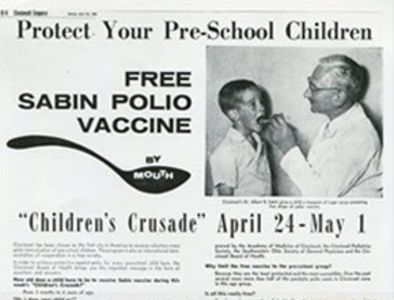
European Journal of Epidemiology Vol. 7, No. 2 (Mar., 1991), pp. 95-120. http://www.jstor.org/stable/3521448 - sent via email from Lora Shimp to The Communication Initiative on February 8 2018; and polioplace website, February 12 2018. Image caption/credit: Advertisement for Sabin Sundays in the Cincinnati Enquirer, 1960. University of Cincinnati
- Log in to post comments