










































Polio Monologues: Translating Ethnographic Text into Verbatim Theatre
University of Glasgow
"...ethnodrama can give a voice to the voiceless, and enable them to contribute to the production of new knowledge, health interventions and policy instruments that affect their lives."
Polio Lives is a 2-stage pilot study that explored the potential of interdisciplinary methodologies to exchange and communicate knowledge about the social history of polio to different communities in creative ways. Following a historical review of poliomyelitis and Post Polio Syndrome (PPS) in the United Kingdom (UK) context and internationally, and in the context of Polio Lives, the article discusses the life history approach and the value of connecting biography and history to understand disability, disease, and social change over time. This is followed by examination of the potential of translating biographical narrative into theatre, engaging with debates of how theatre is not just about providing entertainment but also can be used to inspire thought, emotional reactions, and critical engagement in relation to historical disease and disabled lives.
Mass vaccination programmes mean that poliomyelitis is almost a forgotten memory in the Global North; thus, this article examines it as a "historic disease". As reported here, 25%-50% of those who contracted childhood paralytic polio in the post-war years develop further functional deterioration (that is, PPS) in late adulthood. The self-told stories of the polio survivors collected for the Polio Lives study reveal how the medical institutional regimes and technologies impacted the private lives of children and young people living with paralytic polio in post Second World War Britain, particularly in terms of intergenerational relationships and self-identity. The impetus for this article is that the process of using recorded delivery verbatim techniques with disabled and non-disabled actors can translate ethnographic research about social history of polio into a creative accessible medium for new generation audiences to learn about the hidden, often contested, histories of disability and disease that may clash with professional, medical, and public discourse.
The idea is that performative engagement with the lives of polio survivors enables a way of learning about the relationship between the past and the present - about intergenerational and interrelational relationships and the role of agency in the construction of social change. It also offers opportunities for polio survivors, a historically marginalised group, to "speak for themselves" and share their experiences with the physical, social, and psycho-emotional impacts of disease, both for the individual and wider communities. In fact, the educational value of drama-based performance has not gone unnoticed in the world of health care and medicine. At the same time, disability arts practitioners, academics, and activists have engaged in debates concerning the cultural representation of disability in observing the broad under-representation of disabled people in mainstream media, the narrow range of images used to signify disability, and the limited number of disabled performers in professional practice.
Initiated in January 2015, the first stage of Polio Lives involved conducting 5 life history interviews with survivors of childhood paralytic polio, contracted during the UK polio epidemic in the 1940s and 1950s. For example, "Red Rich", one of the male participants who contracted paralytic polio in 1949 (at 9 months old), remembers that he did not identify as a disabled person or a "polio survivor" until he was in his forties. His story demonstrates how this was influenced by his parents' denial of his impairment, which impacted on his psycho-emotional well-being. Selected quotes from these transcripts are used to illustrate various points throughout the article.
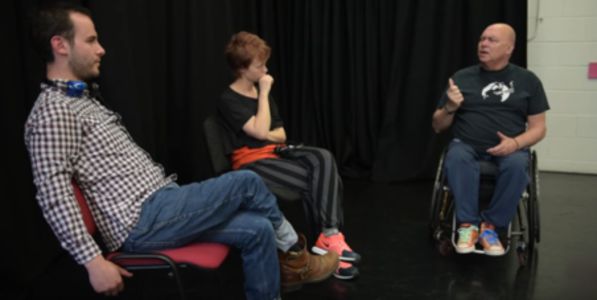
The second stage of the study involved collaborating with Birds of Paradise, a Scottish theatre company working to promote deaf and disabled artists, to run 2 weeks of workshops to explore how to tell the story of polio through recorded delivery verbatim methodologies. This process involved re-interpreting life history data into a theatrical performance. The final performance was a recording comprised of intercut selections from the interviews with 2 of the polio survivors conducted in stage 1. The 30-minute scratch performance featured 2 actors (a disabled man and non-disabled woman) performing selections of the original interviews to an invited audience at the end of the second week. As a scratch performance, this presentation was staged without costume or theatrical lighting in a small studio space - a functional minimalism which may have contributed to the sense that the performers were not simply "pretending". An improvisational score of movement accompanies the vocal performance. Though these movements sometimes reflected literal actions described within the spoken text, they were more frequently abstract. The workshops, scratch performance, and post-workshop discussions with the creative team were video-recorded and edited to produce the short documentary Polio Monologues, available below. This film was presented at the British Sociological Association Medsoc, the Festival of Social Science, and the International Federation of Theatre Research in 2016.
The article delves further into the practice of recorded delivery, a verbatim theatre method developed by the director and playwright Alecky Blythe. In its simplest form, Blythe's method involves the simultaneous playback and performance of verbatim interview material that has been edited to produce a dramatic composition. Wearing earphones, actors listen to the speech of the interviewees and attempt to reproduce the delivery of that original speech, preserving the tone and emphasis of the speaker while reproducing the hesitancies, errors, and stutters of everyday speech. Listening to the recordings and repeating what they hear immediately after they hear it, actors in recorded delivery performances are tasked with a form of responsive mimicry rather than the development of fictional character, working only from the audio recording and without the use of a transcript.
During and following the workshop process, the creative team were invited to reflect on the process of working with the life history interview material. Through these reflections, it was apparent that the experience of working with the research material had been informed by the intersection of company members' own experiences and life histories of disability in general, and polio in particular. The article discusses the challenges and debates concerning the representation of disability on stage, including the conventions of performance used to demonstrate the physical, social, and psycho-emotional implications of having an impairment, without impersonating the disabled character. Actors used the technique of "becoming", as opposed to "pretending" to tell the story of polio lives. As per the social model of disability, actors demonstrated the experience of disability in the lives of the characters, as well as points of resilience and overcoming limitations of opportunity.
In conclusion: "Listening to, and embodying real life narratives using drama techniques not only provides actors with an awareness and deeper understanding of lived realities of poliomyelitis, but also has the potential to enact a kind of activism and a change in public perceptions towards disabled people, previously shaped by negative representations in popular culture."
Qualitative Research 1-17. DOI: 10.1177/1468794117696141. Image credit: Sonali Shah via YouTube
- Log in to post comments