










































Polio Transition: Turning the Challenge into an Opportunity - Session 3: Global Immunization Meeting (GIM) 2018
From June 26-28 2018, over 200 participants representing immunisation stakeholders and partners at global, regional, and country levels gathered in Kigali, Rwanda, for the Global Immunization Meeting (GIM). Co-hosted by the World Health Organization (WHO) and the United Nations Children's Fund (UNICEF), the meeting had as its theme Navigating Transitions. This provided an opportunity to work toward a common understanding of current changes such as Gavi transition and polio transition, and to explore new directions for action as the Global Vaccine Action Plan (GVAP) comes to a close in 2020.
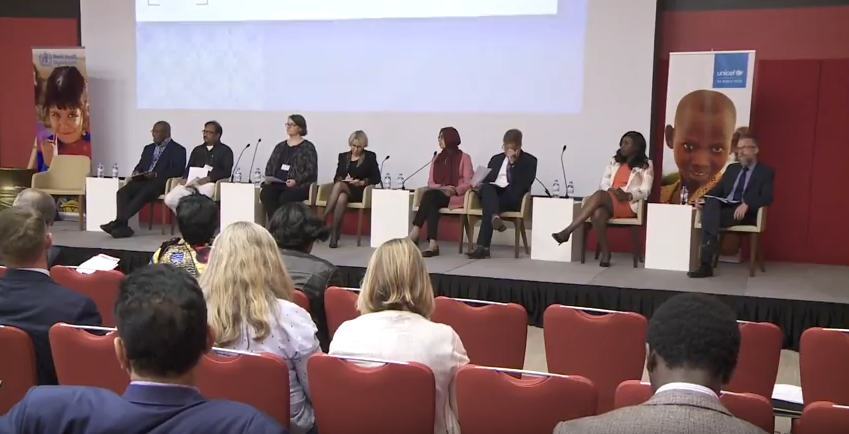
This video, one of several shared from the event (for others, see the GIM 2018 website), captures a session focused on polio transition, specifically. With 11 cases today, polio is at an historic low and is drawing closer to eradication. This means that resources are going to decline in many countries (delivery of immunisation services has been heavily cross- subsidised by polio funding), which presents risks but also an opportunity to shift the paradigm and for the creation of a new vision of how we could do things in terms of pushing to improve and sustain immunisation coverage achievements in the absence of polio campaigns. Polio-funded staff conduct active case-based surveillance for polio, measles, and other diseases and are often the first-line surge staff to respond to an emergency or an urban outbreak. They help engage hard-to-reach communities, mobilise demand, and provide the backbone of stronger health systems. It is not realistic to assume that one single health programme or initiative can absorb all those functions; it will be necessary to work collectively to move forward.
After those introductory comments, the video features several people giving TED-style talks, each speaking up to six minutes in order to introduce the subject. Some of the communication-related topics they covered:
- In Nigeria, the use of smartphones to improve data quality
- In India, the repurposing of polio infrastructure through the Pulse Polio programme to serve the broader health agenda.
- Globally, the building up of various surveillance support functions in countries, including governance infrastructure, coordination and evaluation of workforce capacity, communication monitoring, and evaluation and supervision.
- In Pakistan, the role of accountability in the polio programme, and the huge cadre of frontline workers trained to be reliable and trustworthy as they sought to reach each and every child - e.g., even in conflict-affected areas. They used very strong communication in these efforts, which can be integrated into the routine immunisation programme. A challenge is that the programme has been successful in that it has been reaching out to each and every door and each and every child, yet parents have not started coming and demanding polio vaccines.
- The importance of civil society going forward. When civil society organisations (CSOs) put forward their own services, it will be necessary to ensure that voices of communities are heard, since the polio programme has not created demand. Civil society can put forward its own value of being present right at the community level by having credible relationships with the fragile and conflict-affected areas within hard-to-reach areas in economically poor communities. CSOs can play a role in conducting qualitative research - capturing the perspective of the community so as to document best practices and design social mobilisation efforts.
- How CSOs can be a part of the solution to funding challenges by advocating for realigning partnerships to strengthen immunisation as a first part of the post-2020 agenda. Civil society is not one single, homogeneous entity; it is very diverse and includes community-based organisations, non-government organisations, international non-governmental organisations, professional associations, and community and citizens' groups. Civil society actually brings the power of a vast array of skills and expertise that can be deployed for immunisation for broader health of a primary health care system. In addition to the social mobilisation and demand generation activities they undertook for polio, they are able to engage parliamentarians and legislators to pass laws that will speak to governments and domestic funding. They also hold governments accountable. The CORE Group, which has worked on polio in India and a number of countries, were initially involved in social mobilisation, but being in the communities and gaining the trust of the communities really meant that they needed to shift that focus to meet the needs of the communities to broader maternal and child health issues, and they did just that. The same goes for civil society. If the voices are not in the room, then it becomes very difficult to get that input. They are part of the social and normative fabric in the community, so they bring those voices - those nuances - that really will help any programme move forward.
- The many different ways and formats the polio programme has pursued to create political will - such as by leveraging traditional leaders to create support for the programme at the highest levels.
- With regard to sustainability, Gavi's request that their teams engage much more proactively in dialogues at the country level - in particular in those countries that have had a huge polio legacy yet still have extremely weak systems. The goal is to see where and how we can best seize this opportunity and integrate what has worked well from polio and the assets that are there to strengthen routine immunisation.
- The United States Agency for International Development (USAID) is working with a group of partners to document what has worked in polio eradication community engagement communication and how can that be helpful as a document that anyone can use.
Global Immunization News (GIN), June 2018 [PDF], and GIM 2018 website, July 10 2018.
- Log in to post comments