










































Routine Childhood Immunization: Insights for Improving Malaria, Family Planning, and Maternal and Child Health Outcomes in Northwestern Nigeria through Social and Behavior Change Research
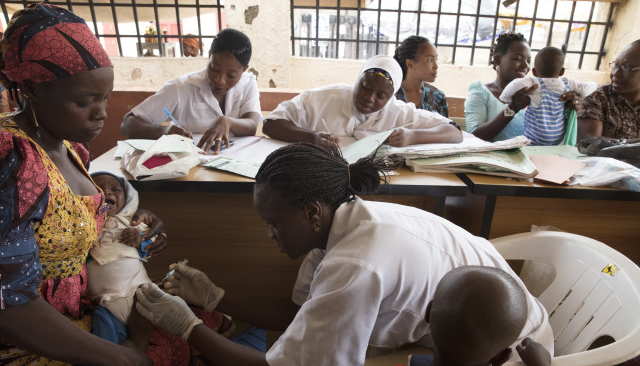
"The results indicate an important role for SBC [social and behaviour change] programming to achieve substantial improvements in routine childhood immunization practices in northwestern Nigeria, even in the absence of other changes."
Family decision-making processes around vaccination are multifaceted and influenced by a complex interaction of knowledge, beliefs, social norms, and other psychosocial factors. In West Africa, childhood immunisation rates still lag behind much of the world. To explore reasons for these persistently low rates, Breakthrough RESEARCH, a United States Agency for International Development (USAID)-funded project, conducted a study to look at the behavioural drivers of decision-making about vaccines in Nigeria. This research brief describes different barriers to routine immunisation uptake, quantifies the importance of ideational factors on vaccine behaviours, and measures the extent to which social and behaviour change (SBC) programmes may effectively change vaccination practices by targeting identified psychosocial influences.
Results are based on the behavioural sentinel surveillance baseline survey that was conducted between September and October 2019 in programme areas of Breakthrough RESEARCH's sister project, Breakthrough ACTION, in Kebbi, Sokoto, and Zamfara. The sampling method included a census of 3,032 pregnant women and a random selection of 3,043 women with a child under 2 years of age.
Key findings:
- Only 6% of children aged 12-23 months were fully immunised by their first birthday. Vaccination coverage inequities exist, with less than 4% receiving all basic vaccinations in the lowest, second, and middle wealth quintiles, compared to 9% and 16% in the fourth and highest quintiles.
- Barriers included low vaccine knowledge, common myths, spousal opposition and health services problems:
- Only 25% of respondents knew that a child should get their first routine immunisation at birth. Nearly half (46%) said they did not know the timing of the first vaccination.
- Nearly one-quarter cited vaccine concerns as reasons for not getting their child vaccinated including fear of needles (11%), fear of side effects or safety issues (10%), or lack of effectiveness (2%). Among women who did not vaccinate their youngest child, 33% cited spousal opposition as a reason for not doing so. Over one-third cited an issue related to health services quality.
- 28% believed vaccines were either not effective or were unsure about their effectiveness, and 54% believed that or were unsure if vaccines contain chemicals that are dangerous to a child's health. Women who believed the illnesses vaccines prevent are severe were 2.6 times as likely to have a child vaccinated against measles or with 3 doses of diphtheria, tetanus, and pertussis (DTP) vaccine.
- Beliefs about what others do (social norms) and antenatal care (ANC) attendance also matter:
- Women who believed that most women in her community trust immunisation health providers were 3.1 times as likely to have her child receive 3 doses of DPT vaccine.
- Women who attended antenatal care at least 4 times were more than twice as likely to have a fully vaccinated child than non-users.
These results highlight that communities in Northwestern Nigeria need more knowledge about the safety, efficacy, and appropriate timing of childhood routine immunisation. This information needs to reach both parents and caregivers, particularly in contexts where power imbalances in decision-making are most dynamic.
Along these lines, although factors such as distance to health facilities and quality of care played a role in whether young children received vaccines, the study highlights the influential role husbands and health workers can play - suggesting that efforts to increase knowledge and address misconceptions about vaccines must identify and reach out to individuals who influence women's decision making. Specifically:
- Almost three-quarters of respondents reported that their spouse influences their decision to vaccinate a child. Women whose husbands supported their vaccination decision were 60% more likely to have their child receive all 3 doses of DPT and 40% more likely to have their child receive the measles vaccine than those without spousal support.
- Women who said health providers influenced their decision were more than twice as likely to have their child receive all basic vaccinations. Thus, a key strategy could be to ensure that health workers have comprehensive information about the safety and efficacy of vaccines and counsel women using this information, especially during antenatal or postnatal visits.
This brief is one of a series that presents data on a range of psychosocial drivers of behavioural outcomes in the areas of family planning, malaria, and maternal, newborn and child health, and nutrition (MNCH+N). Breakthrough RESEARCH suggests that the evidence-based insights outlined in this brief (and others in the series) could be of value to implementers and researchers of SBC programmes that seek to improve community knowledge, attitudes, norms, and behaviours for improved health of women and their young children. Breakthrough ACTION is using findings such as those shared above to address drivers of vaccine hesitancy for both COVID-19 and routine childhood vaccinations.
"Understanding Hesitancy for Childhood Vaccines in Nigeria - It's Not Just About COVID-19", by Udochisom Anaba and Marissa Pine Yeakey, New Security Beat, July 28 2021 - accessed on August 5 2021. Image caption/credit: Mothers have their babies vaccinated at the Primary Health Care Maraba, in Karu, Nigeria. Dominic Chavez/The Global Financing Facility via Flickr (CC BY-NC-ND 2.0)
- Log in to post comments