










































Significance of a Social Mobilization Intervention for Engaging Communities in Polio Vaccination Campaigns: Evidence from CORE Group Polio Project, Uttar Pradesh, India
CORE Group Polio Project (Choudhary, Solomon, Awale, Dey); Indian Institute of Health Management Research (IIHMR) University (Choudhary, Singh); Johns Hopkins Bloomberg School of Public Health (Weiss)
"Any public health program that faces the challenges of resistance or low acceptance can employ the community engagement strategies and approaches similar to the Polio SM Net initiative."
Globally, many public health programmes apply community engagement strategies such as social mobilisation (SM) and social and behaviour change communication (SBCC). One such example is CORE Group Polio Project (CGPP) India's network of social mobilisers called Community Mobilization Coordinators (CMCs), who achieved high coverage of polio vaccination during Supplementary Immunization Activity campaigns (SIAs) in polio high-risk areas of Uttar Pradesh (UP), India, during the effort to eradicate polio from that country. This paper quantitatively measures the extent and outcomes of CMC community engagement in SM interventions and polio SIAs.
The concept of community engagement is complex, reflecting the empowerment of communities, community leaders, and community organisations to achieve the desired goals of different initiatives. For the purposes of this study, community engagement in polio SIAs was considered to be the involvement and support of community members, particularly of family members of eligible children, in the polio vaccination drives. Community engagement in the polio SIAs is an ongoing process and is not limited to vaccination days only. With these concepts in mind, the researchers constructed a Community Engagement Index (CEI).
In brief (for more, see Related Summaries, below), the polio SM Net of UP was established in 2003 by CGPP, the United Nations Children's Fund (UNICEF), Rotary, and the Indian Government's and the World Health Organization (WHO)' National Polio Surveillance Project (NPSP). The UP SM Net's CMCs were supervised by Block Mobilization Coordinators (BMCs), who were in turn supervised by District Mobilization Coordinators (DMCs). These personnel developed SBCC and training materials and implemented SM activities across designated CGPP and UNICEF areas.
One task of the SM Net functionaries was to engage communities before, during, and after each polio SIA. For example, before each SIA, CMCs facilitated various awareness generation and trust-building activities, such as interpersonal communication (one-to-one and one-to-group) with caregivers and family members of children in the SIA age group, meetings with local influencers, and children's rallies. After completion of an SIA, the SM Net functionaries visited all the houses with unvaccinated children and encouraged them to go for polio vaccination in the upcoming/next SIA
The study used secondary, cluster-level data from 52 SIAs held between January 2008 to September 2017 in 56 blocks/polio planning units, covering 12 districts of UP. The researchers used 5 indicators that reflected community engagement in polio SIAs as proxies for success in engaging the community:
- Booth coverage - The percentage of eligible children vaccinated at the polio SIA booths (fixed site vaccination). This indicator "quantifies an important sense of community engagement, ie, the proportion of community members who themselves were active in bringing their children to the SIA booths for vaccination."
- Rate of 'X' houses generated during an SIA - The percentage of households where an unvaccinated child is present or the vaccinators do not know the SIA vaccination status of all children generated during the house-to-house activity of an SIA.
- Rate of remaining 'X' houses at the end of an SIA.
- Refusal rate at the beginning phase of house-to-house vaccination of an SIA - The number of households who refused polio vaccination at the first visit of a house-to-house activity of an SIA (marked as 'XR houses' on the vaccinators' tally sheet) against every 10,000 households visited by house-to-house vaccination teams.
- Refusal rate at the end of an SIA.
The researchers estimated the difference in the CEI between CMC and non-CMC areas using Generalized Estimating Equations (GEE), and they estimated treatment effects through Difference-in-Differences (DID) method using STATA.
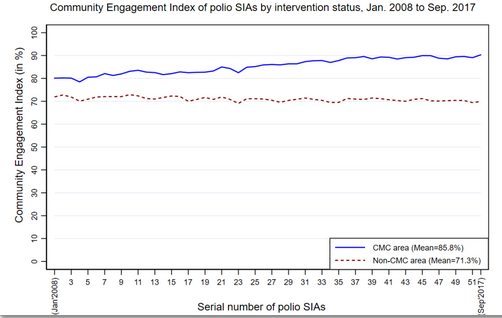
Overall, 78.6% (95% confidence interval (CI) = 78.3, 78.8) of families from the study area were engaged in the polio SIAs, and the extent of community engagement increased over time. The mean CEI of entire study period in CMC areas (85.8%; 95% CI = 85.6, 86.0) was significantly higher (P < 0.001) than that of non-CMC areas (71.3%; 95% CI = 71.1, 71.5). There was a substantial increase in the CEI in CMC areas over time, whereas the CEI trend in non-CMC areas was relatively static. Specifically, the SM intervention led to at least an 11-percentage-point increase in the CEI of CMC areas over time, with about 17% of this achievement attributable to CGPP India's SM efforts. The researchers assert that this increase "made a great difference in engaging communities and building the herd immunity, as most of the CMC areas had pockets of resistance to polio vaccination."
In absolute numbers, out of the 546,314 targeted average households of polio SIAs, the SM efforts of CGPP alone engaged approximately 79,217 families in CMC areas during each polio SIA from January 2008 to September 2017. "Even though the areas designated for CMCs are more challenging for vaccination efforts, the level of community engagement in CMC areas was greater as compared to non-CMC areas."
Reflecting on the findings, the researchers suggest that CMCs "played a significant role in engaging and convincing communities, particularly mothers/caregivers and family members of eligible children, about the benefits of vaccinating their children for polio and other life-threatening vaccine-preventable diseases. CGPP India trained and built their capacities on convincing communities, using community-relevant communication materials and job aids....Also, their critical role was to ensure the childhood immunization of all eligible children, for which they often used local influencers to turn resistant families into acceptors of polio/routine immunization..."
Going forward:
- In order to foster participation in upcoming SIAs, the profile of disengaged families, especially those not bringing children to booths, needs to be studied.
- The finding that there was district-level clustering in CEI implies that district planners need to thoroughly review the performance of polio SIAs, particularly 'booth coverage' of non-CMC areas, and to carry out pre-campaign awareness generation and SM activities.
- Further research can estimate treatment effects and assess the effectiveness of SM intervention in engaging communities during the different phases of the Global Polio Eradication Initiative, or GPEI (e.g., polio-endemic, polio-non-endemic periods).
- The SM Net approach could be adapted to the National Health Mission (NHM) of India, which serves communities for multiple health issues, and the Integrated Child Development Scheme (ICDS) of India.
In conclusion, the findings suggest that intensive SM efforts can significantly increase the extent of community engagement.
Journal of Global Health (JOGH) 2021,11:07011 - sent via email from Ellyn Ogden to The Communication Initiative on March 16 2021.
- Log in to post comments