










































Social Mobilization Campaign to Tackle Immunization Hesitancy in Sargodha and Khushab Districts of Pakistan
University of Sargodha (Malik, Awan); University of Western Australia (Malik); Health Department Punjab (Saleem)
"...findings corroborate the argument that 'package' of intervention including both mobilizers and complementary-materials of mobilisation can win against immunization hesitancy."
In Pakistan, blatant refusals of vaccines are being replaced with immunisation hesitancy, in which parents are weighing arguments for and against vaccination. The concern is that, if people are not engaged appropriately via communication and social mobilisation, doubts about the trade-offs between the benefits and potential side effects can persist. The objective of this study was to explore strategies for improved social mobilisation to reduce immunisation hesitancy.
The study sites were Sargodha and Khushab districts of Punjab Province, where full immunisation coverage rates are 68% and 66%, respectively. The researchers conducted a quantitative survey in August and September 2017 among 329 CHWs involved in a social mobilisation campaign at the union council (UC) level, such as school health and nutrition supervisors (SHNSs), lady health supervisors (LHSs), lady health workers (LHWs), and vaccinators. In addition, qualitative data were collected from management of the Expanded Programme on Immunization (EPI) through key informant interviews (KIIs), and focus group discussions (FGDs) were conducted with parents.
The 3 implementation research assessment parameters were: appropriateness (the intensity of suitability of mobilisation activities to the local context of immunisation hesitancy); acceptability (the trust people conferred on the local mobilisers, community involvement in activities, and the acceptance of new changes in the programme by community health workers, or CHWs); and fidelity (the degree to which an intervention was implemented as it was designed in an original protocol, plan, or policy).
Respondents considered advocacy meetings with local influencers, community group sessions, door-to-door visits by CHWs, and mosque announcements to be the most relevant and appropriate interventions for social mobilisation. Some suggested that government should explicitly issue orders to the imam masjids (mosques) to explain the importance of immunisation after Friday (Jumma) prayers so that people are reminded to abide by the schedule of the vaccination cards and vaccinators' visits to the local community.
Generally, CHWs - who originate from the local community and thus share local language, customs, and traditions - are trusted. In some cases, negative attitudes of people towards immunisation hinder trust towards mobilisers or CHWs. Hence, they leverage active participation of local influencers, teachers, and health department officials to convince such stubborn parents. In fact, as a means to increase immunisation coverage, 67% of the health workers suggested involving more notable people from the local area.
In more detail, respondents suggested that active community involvement through leveraging support from local religious and non-religious influencers in social mobilisation activities increases its acceptance. Community engagement is most effective in rural and hard-to-reach areas when CHWs are skilled in interpersonal communication and information, education, and communication (IEC). One proposal was to develop specific material to engage religious leaders, politicians, health care workers, etc. There is already a practice of writing material with a focus on polio; however, there is no such practice of developing specific material for groups on a regular basis that can help address broader immunisation issues at the social and community level.
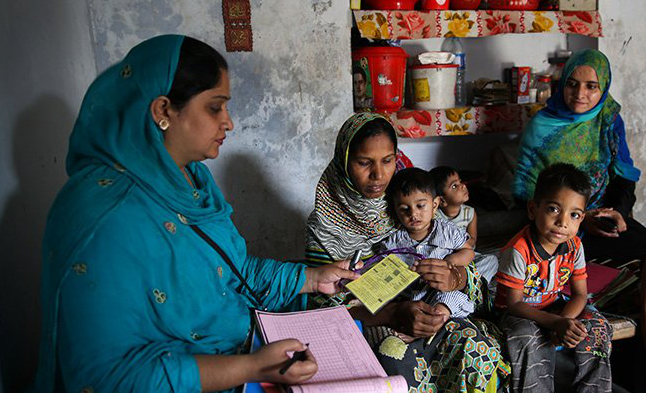
To look in more depth at one social mobilisation activity: Door-to-door visits are very much relevant in the local context because often women are not being permitted by their husbands and/or in-laws to leave house during the daytime to attend women's meetings/health sessions arranged for polio awareness, for example. Furthermore, women in isolated communities like dairajaat (geographically isolated group of people from main dense village settlements and/or uncovered areas where LHWs are not working), brick kiln worker communities, or nomadic groups are difficult to gather (especially in the absence of any monetary or non-monetary incentives) for group awareness sessions because they are busy in their own work and live in far-flung areas. Additionally, there are various so-called religious beliefs prevalent in local areas that do not allow pregnant women to come out of the house or to speak with others outside the home, even in the early months after they have given birth. Such reasons explain why awareness should be provided at the doorstep to ensure that potentially vulnerable women have proper information on health care and immunisation coverage.
In closing, the study recommends some tactical, systemic initiatives to improve social mobilisation implementation for routine immunisation in Pakistan. Specifically, communication committees as oversight mechanisms should be established or reactivated to regularly monitor and support mobilisation activities by liaising with local administration and local influencers to address mobilisers' service-related concerns, community-specific hurdles, and deficiencies in providing awareness materials. Resistant communities' needs can be redressed through rigorous conduct of men's and women's education sessions by CHWs while giving more time and space to mobilisers to take on board local religious and non-religious influencers to convince conservative/illiterate parents. Use of media, public service messages, brochures, pamphlets, and descriptive-cum-pictorial materials should be ensured to enable LHWs to disseminate vaccine-related information and encourage retention of vaccination cards. Such complementary materials can increase the mobilisation efficacy of CHWs.
Journal of Global Health. 2020 Dec; 10(2): 021302. doi: 10.7189/jogh.10.021302. Image credit: © UNICEF Pakistan/2016/Zaidi
- Log in to post comments