










































Strategic Engagement of Technical Surge Capacity for Intensified Polio Eradication Initiative in Nigeria, 2012-2015
World Health Organization, or WHO (Yehualashet, Mkanda, Gasasira, Erbeto, Onimisi, Horton, Banda, Tegegn, Ahmed, Afolabi, Wadda, Vaz); Global Public Health Solutions (Nsubuga)
"Programmatic interventions were sustained in states in which security was compromised and the risk of polio was high, partly owing to the presence of the surge capacity personnel, who are engaged from the local community."
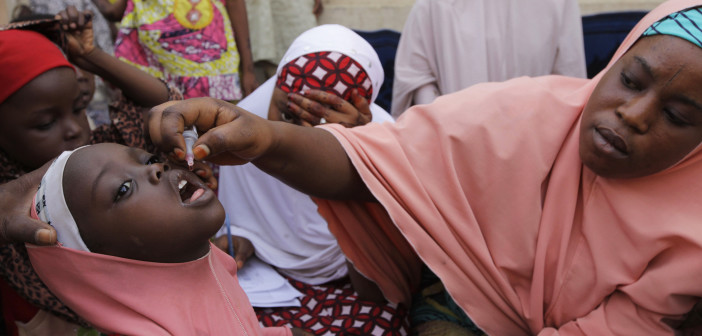
Following the 65th World Health Assembly (WHA) resolution on intensification of the Global Poliomyelitis Eradication Initiative (GPEI), the Nigerian government, with support from the World Health Organization (WHO) and other partners, implemented a number of strategies to curb the transmission of wild poliovirus (WPV) in the country. One of the strategies implemented since March 2012 is the WHO's engagement of surge capacity personnel, which was inspired in part by a visit of Nigerian high-level government officials to India to review factors that contributed to the successes in the polio eradication efforts in that country. One of the lessons learned was the positive contribution of increased immunisation personnel at the local level to intensify polio eradication initiative (PEI) interventions. This strategy was expected to accelerate the operationalisation of the high-level commitment from political, traditional, and religious leaders into improved operational outcome at the local government association (LGA), ward, and settlement levels. This paper documents the recruitment, deployment, and management processes and how implementation of the WHO's surge capacity project contributed to the improvement of PEI and routine immunisation (RI) performance indicators.
The surge capacity project focused on 11 states at high risk for polio transmission on the basis of epidemiological risk analysis and compromised security (hereafter, "HR states"): Bauchi, Borno, Jigawa, Kaduna, Kano, Katsina, Kebbi, Niger, Sokoto, Yobe, and Zamfara. The project aimed to support the HR states to achieve and sustain quality supplemental immunisation activities (SIAs) required to ensure poliovirus transmission is interrupted, to maintain certification standard acute flaccid paralysis (AFP) surveillance, and to improve RI coverage.
The recruitment process commenced after developing terms of reference, key performance indicators, and qualification requirements for each position. The WHO communicated the vacancies through internal notices and existing health networks and then formed an interagency panel comprising representatives from National Primary Health Care Development Agency, the Nigerian Ministry of Health, and the United Nations Children's Fund (UNICEF) to conduct the selection process. Over 2,200 personnel were engaged, of whom 92% were strategically deployed in the 11 HR states. To facilitate acceptance by the community, the surge capacity personnel were hired from the communities where they resided, using suitable contractual arrangement.
In addition to the training conducted to administer selection tests during the recruitment process, the WHO and partners organised and cascaded trainings, which included field visits to health facilities offering RI and surveillance services. The WHO also engaged an international consulting firm to conduct a series of management trainings for top- and middle-level managers, which included topics such as handling difficult conversations, coaching for development, and improving creativity and innovative problem solving skills. In 2014, the WHO introduced a systematic accountability framework and implemented it in all its field offices, using key performance indicators aided by geographical information systems and mobile device technologies, coupled with periodic supportive supervisory visits to the field.
Following the full implementation of the surge capacity, the human resource strength of the WHO increased by >400%. The surge capacity personnel were directly engaged in efforts aimed at improving the performance of polio surveillance, vaccination campaigns, increased RI outreach sessions, and strengthening partnership with key stakeholders at the operational level, including community-based organisations (CBOs). Figure 2 (on page S12) illustrates that 2 core AFP surveillance indicators - the non–polio AFP rate and stool adequacy - showed marked improvement after the introduction of the surge capacity. Although the programme had achieved the threshold target of 2 non–polio-associated AFP cases per 100,000 persons aged 10% children missed by vaccination campaigns decreased from 21% in 2012 to 3% in 2015. As of 19 June 2015, the last case of wild poliovirus (WPV) in Nigeria was reported on July 24 2014. Each state has a goal of conducting 80% of planned fixed and outreach RI sessions. The proportion of sessions conducted improved after 2012, and the target was met in 2015. "The surge infrastructure has also been instrumental in building local capacity; supporting other public health emergencies, such as the Ebola outbreak response and measles and meningitis outbreaks; and strengthening the integrated disease surveillance and response." Guided by surge capacity deployment optimisation analysis and the cumulative feedback during 2014 from the accountability framework, the WHO made necessary adjustments during the 2015 surge capacity deployment (e.g., assigning more personnel to states with persisting security challenges and programmatic priorities).
In terms of other impacts, the researchers note that "[t]he personnel have built up personal relationships with key stakeholders in the community to obtain buy-in for successful implementation of several innovative interventions that have been introduced since 2012." The importance of community involvement is also reflected in this observation: "The surge project gave the program an opportunity to use technically competent health professionals who understand the grassroots' cultural and operational context. As such, they are suited to address challenges unique for every local area in the context of the diverse political, social and economic landscape in Nigeria. Their extended presence at LGA and ward levels created the capacity to successfully translate the high-level commitments and strategies into operational levels."
The researchers conclude by recommending the sustenance of the surge project in Nigeria to maintain the polio programme's momentum and successful implementation of the 2013-2018 global polio endgame strategy and beyond. As part of polio legacy planning, they say, the government and partners should consider leveraging the polio surge capacity infrastructure to support health systems strengthening in general and new vaccine introductions and vaccine-preventable disease surveillance activities in particular "Due to weak health systems in the country, it is vital to maintain a reasonable level of the surge capacity for successful implementation of the 2013-2018 global polio endgame strategy and beyond."
Best Polio Eradication Initiative (PEI) Practices in Nigeria With Support From the WHO: A Supplement to The Journal of Infectious Diseases, Guest Editors: Rui G. Vaz and Pascal Mkanda. J Infect Dis. Vol. 213, suppl 3, May 1 2016: S136-S139. Image credit: AP Photo/ Sunday Alamba
- Log in to post comments