










































Why Vaccine Mistrust Is a Relationship Problem
"In a perfect world, a vaccine for the coronavirus would be available tomorrow. Everyone would get a shot. And the disease would die out. But even if it was available, there are people who would refuse to get it simply because they don't trust vaccines in general." - Manoush Zomorodi, National Public Radio (NPR), host, interviewing Heidi Larson
Heidi Larson, anthropologist and founding Director of The Vaccine Confidence Project (VCP), studies rumours as part of her research on the social and political factors that affect uptake of health interventions and influence policies. Among the factors: Technology has made vaccine-related information available at our fingertips yet has enabled misinformation to spread quickly. In this TEDMED talk, which Larson subsequently discussed on National Public Radio (NPR)'s TED Radio Hour, she argues that the problem of vaccine hesitancy is not due to misinformation per se but, rather, to the lack of relationships around trusted health information.
As Larson explains, while working across the globe on global polio eradication, she has noticed the consequential impact of vaccine distrust and medical rumours. In 2003, while working on a vaccine strategy for one of the Global Polio Eradication Initiative (GPEI) partners, the United Nations Children's Fund (UNICEF), Heidi traveled to northern Nigeria, where a rumour about the polio vaccine was fueling a national health crisis. She says: "The rumors were suspecting that the polio vaccine was actually a contraceptive. It was controlling populations. Maybe it caused AIDS. Maybe it's the CIA [United States (US)' Central Intelligence Agency] spying on them or counting them. I mean, why else would they have people knocking on their door again and again with the same polio vaccine? This wasn't about getting the facts right. This was about trust. It was about broken trust." Larson elaborates in the NPR interview that the resulting 11-month boycott led to over 20 countries being reinfected with polio that had been declared polio-free and cost the GPEI US$500 million. The Nigeria episode was one of many episodes she investigated while at UNICEF, inspiring her to found the VCP.
Larson believes we can inspire trust in medicine, particularly around vaccines, by building a health system that is empathetic and reciprocal. In part, this involves investigating people's confidence in vaccines before there is a crisis, which is the purpose of VCP's Vaccine Confidence Index. Setting up media and social media monitoring to listen for what's going on in terms of vaccine conversation can help researchers pick up early concerns or changes in sentiment. Taking early action could prevent rumours from "jumping" from country to country or continent to continent, via social media, as has happened (e.g., in the case of the human papillomavirus (HPV) vaccine).
Larson explores some of these actions, like training volunteers to sit in waiting rooms, answer hotlines, or engage in online chat forums. They could listen to people's questions about vaccines when a physician is too busy to have those kinds of conversations - that is, they could build relationships. She also speaks hopefully of the younger generation, citing the example of 18-year-old vaccine advocate Ethan Lindenberger. He has spoken out, in a global vaccine summit and on Reddit and other media, about his mother's decision not to have him vaccinated. Lindenberger is concerned about a different kind of misinformation: the idea that vaccine-hesitant parents like his mother are "bad" or unloving. We have an abundance of scientific information to debunk false rumours, Larson stresses; misinformation is "the symptom, not the cause". Empathy, kindness, and understanding can go a long way to building trust and tackling hesitancy.
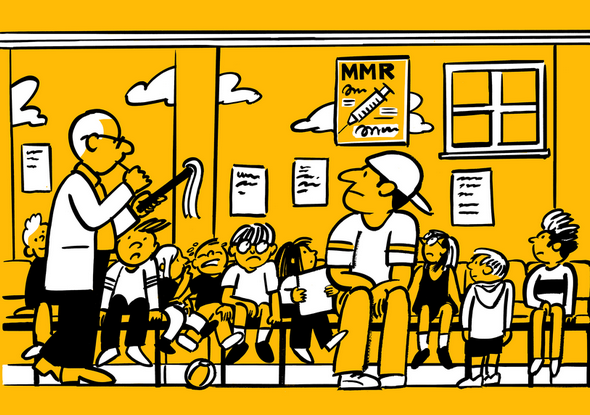
TEDMED and Health News Florida website, both accessed on April 14 2020. Image credit: Illustration: Mark Long/Mark Long for Guardian US
- Log in to post comments