










































The State of Vaccine Confidence 2015
London School of Hygiene & Tropical Medicine (LSHTM)
"Public trust matters. When strong, public confidence and trust can help overcome even the most difficult hurdles - maintaining uptake despite uncertainty and bolstering cooperation in times of crisis. Without trust, even the best science and public health strategies can become impotent."
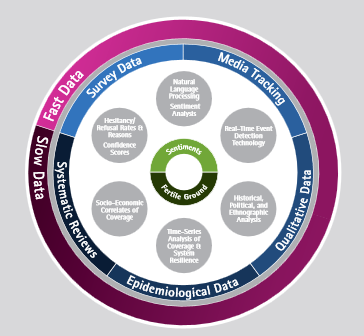
This report: analyses some of the vaccine confidence issues that have occurred with a range of vaccines (such as the oral polio vaccine - OPV), details strategies that have had positive impacts on engaging populations and building trust and confidence, and reflects on what still needs to be learned. It also includes research examining vaccine hesitancy rates in 5 countries, using a tool called the Vaccine Confidence Index, which is designed to start a global initiative to measure confidence in countries around the world.
In the first set of surveys - conducted in the United Kingdom (UK), India, Pakistan, Nigeria, and Georgia - 5,873 parents of children under the age of 5 (under the age of 15 in Georgia) were asked whether they had ever hesitated to vaccinate their children, and, if so, whether they went on to accept or ultimately refuse vaccination. Reported reasons for hesitancy in all countries were classified as being due to either confidence (do not trust vaccine or provider), convenience (access), or complacency (do not perceive a need or value of vaccine). Issues of confidence were found to be the main reason for hesitancy in all countries surveyed. "At the same time as Nigeria was facing the polio vaccine boycott, India was also challenged by pockets of community resistance to polio vaccination. However, with similar strategies of trust building with local communities and partnering with local trusted institutions, India made tremendous strides and successfully eliminated polio, being declared polio free in January 2014. Both Nigeria and India have shown that confidence challenges can be overcome."
Some of the strategies that the researchers found to be promising are described in the excerpt below. It is noted that: "[t]he surveys will be expanded globally in the future to include more countries around the world, with results updated online and repeated over time. The report authors say it is imperative to global public health to understand the dynamics of vaccine confidence among the public, health providers and politicians or policy makers."
An excerpt from the concluding section of the document follows:
"The cases discussed in earlier chapters teach us that vaccine confidence is not just about vaccines. Example upon example illustrates the manifold forms that doubt and distrust can assume - boycotts, bans, protests, and all manner of grievances - many of which are well beyond the realm of medical science, but driven by politics, values and emotions embedded in the people and societies which medical interventions seek to serve. For this reason, health science alone cannot achieve the aspirational goals of immunisation programmes, and engagement is needed well beyond the health sector....[I]t is also clear that confidence-building within the health sector itself is important. Providers need to feel confident in the safety of the vaccines they are recommending, and confidence in answering the growing number of questions from parents. Providing an environment that helps build confidence is especially important for those health providers who are delivering vaccination in dangerous areas such as North-West Pakistan, where they have been targets of violence, in conflict-ridden areas such as Syria, or amid humanitarian disasters such as the Ebola outbreak in West Africa....The third dimension of confidence discussed in this report is the confidence of politicians and policy-makers to stand up for the science behind vaccines and vaccination while remaining responsive to the concerns of the public...
Some key recommendations
- Increase the number and diversity of citizen members on advisory bodies without reducing scientific expertise.
- Give the public sufficient information and adequate time to understand the rationale for any new vaccines before embarking on immunisation campaigns, which can be done without delaying protection.
- Engage local communities and parent groups as advocates of new vaccines.
- Avoid the hyperbolic marketing practices of overselling.
- Take the time to explain changes in recommendations and policies...
- Invest in research on what is truly driving parents' questions and concerns...
...Other, additional research questions are emerging, particularly in the area of research methodologies, as discussed in Chapter Three, to investigate the complex arena of vaccine confidence and the psychological, social and political influences that define it...
- Key recommendations...
- When introducing a new vaccine, think beyond the vaccine and the vaccination to consider the contextual historical as well as current societal and political factors that could influence public confidence in the vaccine and the vaccination programme. Sometimes the solution lies outside the vaccination programme.
- When countering a negative rumour or conspiracy theory, consider the 'fertile ground' factors that make the rumour popular in the first place. Sometimes changing delivery strategies, or actors can dispel rumours, which are just the face of other underlying issues.
- Religious figures can be strong allies for immunisation programmes, as they are invested in the well-being of their followers. When excluded, religious leaders can also become barriers to public confidence in vaccines. Do not dismiss public concerns just because they are based on faith instead of evidence. Respect beliefs, while trying to find other ways to make vaccination acceptable.
- Target engagement efforts at vaccine-hesitant groups....They are reluctant, seeking answers to their questions, and are yet undecided and need the support to make the most informed decision.
- Vaccine confidence is not just about vaccines - confidence in and by providers and political leaders is key.
- Health science alone cannot achieve immunisation goals - political and social scientists are needed along with risk and decision-making experts.
- Confidence building within the health sector itself is important - providers need to feel confident in the safety of the vaccines they are recommending and confidence in answering the growing questions from parents. Providing an environment that helps build confidence is also important for health providers working in conflict or other humanitarian situations...
- Never underestimate the importance of listening and public engagement. This...process needs to start from the planning stages and throughout implementation of vaccination programmes. Sentiments can, and do, change. Listening and engagement needs to be ongoing.
- Trust is built over time, brick by brick, from individual acts of goodwill. It requires genuine care for and accountability to the general public. The task that stands before public health leaders is to listen to their publics, hear their concerns, and take them seriously."
Emails from William Schulz to The Communication Initiative on May 1 2015, June 5 2015, and June 25 2015; and the LSHTM website, accessed May 1 2015. Image credit: Vaccine Confidence Project
- Log in to post comments