










































Childhood Immunisation in South Asia - Overcoming the Hurdles to Progress
UNICEF Regional Office for South Asia
"Community engagement relies not just on information sharing and awareness raising but also on a dialogue that enables public health professionals to understand the needs and concerns of caregivers and community leaders. Immunisation programmes need to factor that dialogue into systems for delivery of vaccines."
In South Asia, as many as one-quarter of children are under-immunised. In this article, Andreas Hasman and Douglas Noble of the United Nations Children's Fund (UNICEF) describe some of the hurdles to progress that still exist and the variety of strategies that can reduce vaccine-preventable child mortality. They offer these thoughts in the context of the observation that immunisation is a core intervention to reduce child mortality, globally averting an estimated 2.5 million child deaths every year. Most South Asian countries started routinely immunising children in the 1980s, with the introduction of the standardised schedule for the Expanded Program on Immunization (EPI). However, in 2012, 8 million of the world's 23 million under-immunised children lived in South Asia, most of them in India, Pakistan, and Afghanistan. The region as a whole is still faring relatively poorly, with 76% coverage of diphtheria-tetanus-pertussis (DTP3) in 2012. In 2012, the Global Vaccine Action Plan (GVAP) 2011-2020 was adopted by the World Health Assembly (WHA). GVAP acknowledged that in order to maximise the benefits of vaccination, immunisation programmes should aim to extend DTP3 coverage to 90% in every country by 2015, with each district having at least 80% coverage, with a focus on children from the most disadvantaged communities. South Asia lags behind; for example, in Afghanistan's Farah Province, immunisation coverage is less than 3%.
The authors describe some of the challenges for improving immunisation coverage are common to the countries of South Asia, including communication-related challenges. For instance, there are difficulties in accurately forecasting demand for vaccination, as population data are often of poor quality or outdated. This impedes the identification of children who have not been vaccinated, reaching those who have "dropped out" between doses and getting the right number of vaccines to the right place at the right time. "Low demand for vaccination among caregivers is another bottleneck." While "outright opposition to vaccination is becoming a marginal phenomenon", the authors suggest that vaccination hesitancy, in which caregivers rationally balance arguments for and against vaccination, is increasingly becoming an issue in South Asia. In India, for instance, the reasons that caregivers most often give for non-participation in routine immunisation is that the need is not obvious and that they do not know enough about the vaccines. Accurate planning with a focus on equity is also a challenge. Essential to good micro-planning, the authors say, is a focus on the "reaching every community" (REC) approach. REC puts the focus on health centres and communities working together to improve immunisation services in the most disadvantaged communities and develops systems to ensure access, quality, capacity building of staff, and accurate recording of data.
Some countries in the region have successfully navigated these challenges, drawing on strategies that include communication-focused approaches. For example, starting in the mid-1980s, Bangladesh reinvented its EPI and invested heavily in infrastructure and training. In addition, a new system for systematic outreach was introduced, in which community health workers (health assistants) provided almost all vaccinations, significantly improving access to routine immunisation. Communities were mobilised and awareness and demand generated locally through partnerships between government, non-governmental organisations (NGOs), and the private sector. In Bangladesh, DTP3 immunisation coverage increased from 69% in 1990 to above 90% from 2005 onwards. The authors also reference supplementary immunisation activities (SIAs) as one means of addressing vaccine hesitancy. Often used in areas where routine coverage is insufficient to achieve herd immunity, SIAs have been used, for instance, in Afghanistan, to achieve coverage that is much higher than for polio vaccination in the routine programme. SIAs can strengthen management, build capacity for addressing vaccine hesitancy and dropouts, and increase confidence in the health system.
In addition, they note, several national immunisation programmes in the region have systematically used communication and advocacy activities to change parental behaviour, counter vaccine hesitancy, and increase demand for vaccines. In Nepal, district public health offices have in recent years turned to female community health volunteers to initiate discussion about the benefits of immunisation at village and community levels. Since 2014, due in part to awareness-raising campaigns, approximately 1,500 villages have been declared fully immunised (over 90% coverage), with all remaining villages in the country to follow by 2017. "Demand generation activities such as this can foster dialogue about vaccines at policy and community levels, increase social approval and political support for immunisation, and improve knowledge of the risks of infectious disease and the means of prevention."
The final section of the paper outlines specific actions for countries and partners. To cite one of them: "The value of inter-personal and social communication to change behaviours is frequently undervalued in immunisation. This is a problem because it contributes to a lack of awareness in caregivers and leads to an absence of community accountability. Only when the benefits of immunisation are widely acknowledged can communities hold local officials to account and harness the real meaning of demand generation."
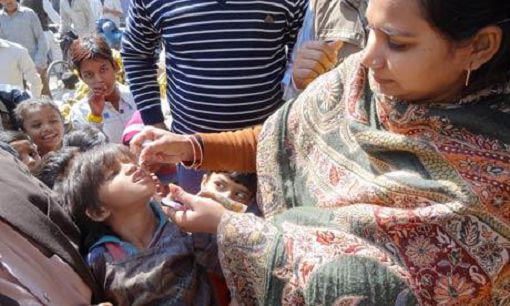
Perspectives in Public Health, September 2016 vol. 136, no. 5, pps. 273-277. doi: 10.1177/1757913916658633. Image credit: Esha Chhabra. India, 2013
- Log in to post comments