










































Even the Smallest Question Should Be Answered
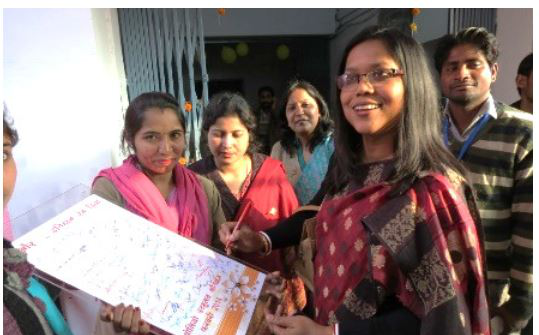
"Unless we work at the community level, we're not getting the full story. Ensuring community participation is the only way to achieve social transformation and to ensure that all children get immunized." - Rina Dey
In this news story, posted on the Global Polio Eradication Initiative (GPEI) website, Rina Dey, Communications Director for CORE Group Polio Project India, explains why listening and answering the smallest questions of communities is key to ending polio. Dey has worked for over 25 years on the front lines in a country that was once thought to be the most difficult place in the world to end polio. She contends that the ability to work one on one with communities in high-risk areas was key to the progress that led to India's being declared wild polio virus (WPV)-free on March 27 2014.
Some of the challenges Dey and her fellow frontline workers had to overcome to foster vaccine acceptance were misinformation and rumours (e.g., that vaccines can cause infertility) and not enough engagement between community members and the immunisation team.
In this interview with GPEI, Dey describes how she and her team addressed these and other issues; some of the key lessons include the need to:
- Invest in frontline workers, ensuring they have the knowledge and skills to effectively deal with situations of oral polio vaccine (OPV) refusal and to ensure that communities are receiving accurate information to make choices about the health of their families.
- Build trust by taking the time to listen to communities and cultivating an attitude that every question and concern deserves to be heard, understood, and acted upon.
- Develop simple and user-friendly information, education, and communication (IEC) materials and methods that are local, easy to use, and participatory.
- Relate to people on a human level first - vaccine acceptance is about something very personal: the health of a person's family - before giving directives or launching into the science behind vaccines.
- Ramp up the engagement of a wide range of influencers, including prominent members of the community, parents, schools, local government, and families, to ensure the flow of accurate information about the eradication effort and OPV.
- Involve women - not only as health workers and vaccinators, but as senior team members. Dey suggests, "When women are in leadership positions, you find that other women are promoted and women's voices from community level are more often heard."
In conclusion, Dey comments: "We must move away from being instructive and take the time to listen and see people's concerns as valid and to help people understand the science behind what we’re asking them to do."
Email from Rina Dey to The Communication Initiative on November 17 2020. Image credit: © CORE Group Polio Project
- Log in to post comments