










































Combining First Nations Research Methods with a World Health Organization Guide to Understand Low Childhood Immunisation Coverage in Children in Tamworth, Australia
University of Newcastle (Thomas, Bolsewicz, Durrheim); Hunter New England Local Health District (Allan, Taylor, McGrady, Islam, Cashman, Creighton)
"Using First Nations research methods was essential in providing deep understanding of the reasons why some children may be falling behind in their immunisations and what might be done to improve coverage rates."
First Nations people often face barriers when accessing health services. The National Immunisation Strategy for Australia 2019 to 2024 aims to achieve 95% coverage for First Nations children, who are recognised to be at increased risk of vaccine-preventable diseases, particularly in areas where coverage is low. This paper explores the work of a group of researchers to identify and understand these pockets of low immunisation coverage in First Nations children in Tamworth, a town in New South Wales (NSW), Australia. The qualitative study incorporated First Nations' ways of knowing and doing into the World Health Organization (WHO)'s Tailoring Immunization Programmes (TIP) methodology (see Related Summaries, below).
As the researchers explain, TIP uses social science and community engagement and is underpinned by the COM-B model of behaviour change, adapted for vaccination and the TIP approach. COM-B encompasses individual factors that influence behaviour, including capability and motivation, and contextual factors, including opportunity, which may be social (cultural norms, demands, support) or physical (access to services). TIP uses, first, quantitative methods to identify areas of low coverage within a population and, second, qualitative methods to determine barriers and drivers to vaccination in that community. This article reports on the first two phases. (The third phase leverages these insights to co-design an evidence-based strategy to achieve high and equitable vaccination uptake. This phase is followed by monitoring and evaluation of the new strategy.)
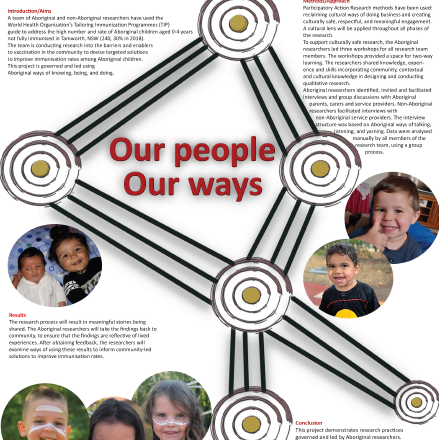
In 2019, Tamworth had 179 (23%) children who were overdue for immunisations. To gain a deeper understanding of why these children were behind schedule and what might be done to improve coverage, the researchers used a participatory action research (PAR) approach. PAR has been described as a collaborative and culturally appropriate methodology to use with First Nations communities, as it recognises both community members' expertise and researchers' technical skills.
Specifically, prior to commencing the study, three capacity-building workshops were held in which First Nations and other researchers shared knowledge, experience, and skills to build capacity to conduct qualitative research with cultural sensitivity. The workshops provided a space for two-way learning, where mainstream researchers shared knowledge, experience, and skills in designing and conducting qualitative research, and First Nations researchers shared cultural knowledge and community ways of working together. The research team then identified potential community participants with experience, knowledge, or insight into childhood immunisation for First Nations children in Tamworth to take part in the study. First Nations researchers then conducted interviews and yarning sessions with 12 First Nations parents/carers of young children and 38 health service providers. Yarning sessions are conversations involving the sharing of stories and the development of knowledge, prioritising First Nations ways of communicating that are culturally prescribed, cooperative, and respectful.
The study highlighted a number of factors contributing to lower coverage, including service access barriers, negative media messages, and suboptimal use of coverage data. Translating the findings into the COM-B model of behaviour change, the study found that capability factors (parents' knowledge, communication from health service providers) and motivation factors (parental attitudes and confidence in vaccination) are contributing to low immunisation coverage in Tamworth. However, opportunity factors (cultural appropriateness of services, physical access, and use of data) also play a role.
Four main themes that emerged that suggest avenues for work to address these barriers include (illustrated in the article by quotations from participants):
- Cultural safety in immunisation services provides a supportive place for families. For example, employing culturally knowledgeable staff, preferably First Nations people who understand and respect cultural and community values, might foster more "family centred" care, in which extended family members are encouraged to come into the consultation room, not only one parent and the child.
- Service access could be improved by removing physical and cost barriers. For example, a broader model of care could incorporate help with transportation, outreach services, drop-in clinics, and extended hours.
- Positive stories and trusted information about immunisation can promote confidence for parents who are unsure. For example, a working group composed of First Nations people and health providers was proposed as a trusted source of information and a group that should be consulted in designing and disseminating culturally appropriate health information (i.e., clear, jargon-free messages using visual or story-based formats and possibly incorporating artwork and analogies). Having a consistent message on immunisation across government, health services, and the community was further discussed as a way to build trust with families.
- Immunisation data can be used to increase coverage rates for First Nations children. For example, due to errors and delays in data entry and failure to share data widely, some providers reported being surprised to hear that First Nations children were falling behind. A few expressed a desire to know whether they were registered with their service so they could follow up with them. Some services used practice software to generate reminders, and many parents commented that this was really helpful, especially if reminders were sent more than one day in advance.
Reflecting on the research experience itself, the researchers note that "[c]ommunity engagement, PAR, and a process led by First Nations researchers helped create a trusting environment where information was shared and findings were genuine...[S]tudy results were interpreted in a way that was culturally relevant to First Nations community members, service providers, and researchers, building on strengths and identifying opportunities for improvement."
One avenue for future research is related to participants' reports of sensationalised anti-vax stories on social media and some negative experiences with immunisation. "Hesitancy has not been reported in previous studies with First Nations communities, and [t]his emerged as an area where further study is needed, particularly for first-time single mothers who may lack family support and encouragement to vaccinate their child, and who may be influenced by negative messages in the media."
The third phase of TIP in this setting will involve development of an evidence-based, tailored strategy to increase the full and timely immunisation of First Nations children in Tamworth, with First Nations' methods, participation, and governance playing a central role.
In conclusion: "Strengthening the First Nations workforce, using language that families understand, linking culture to immunisation health messages in a way that empowers families,and improving use of data to plan and evaluate immunisation services are...strategies within reach of both public and private health services in Tamworth."
The International Indigenous Policy Journal, 12(2). https://doi.org/10.18584/iipj.2021.12.2.10959; and email from Katarzyna Bolsewicz to The Communication Initiative on August 2 2021. Image caption/credit: Poster (from the TIP in Tamworth study) presented in 2019 by the Aboriginal research team members at South Australian Health and Medical Research Institute (SAHMRI) showcase in Adelaide - courtesy of the authors
- Log in to post comments