










































Epidemic Prevalence Information on Social Networks Can Mediate Emergent Collective Outcomes in Voluntary Vaccine Schemes
The Institute of Mathematical Sciences, CIT Campus (Sharma, Menon, Sasidevan, Sinha); Cochin University of Science and Technology (Sasidevan)
"Vaccine hesitancy typically rises with decreasing disease incidence as a consequence of reduced risk perception among individuals of contracting the disease. Understanding the mechanisms driving such behavior is important as it can reverse the success of any immunization program close to achieving the eradication of a disease."
A major factor underlying the success of voluntary vaccination schemes is public perception of the costs and benefits associated with vaccines. Individuals may avoid vaccination if they perceive the risk of infection to be low compared to the potential hazards and inconveniences associated with getting vaccinated. However, in the course of an epidemic outbreak, individuals may opt to vaccinate because of the associated higher risk perception. Modeling individual decision-making in the presence of an evolving epidemic using games, the researchers show that spatial heterogeneity in vaccine uptake behaviour emerges with the spread of disease on social networks. The results highlight the importance of the information source shaping an individual's risk perception for achieving high vaccine coverage.
The researchers explain that, in principle, any disease caused by a pathogen that only has human hosts can be eradicated by mass immunisation, provided there is a sufficiently efficacious vaccine that is readily available. Such an outcome has been realised for smallpox and is expected to be achieved for polio. However, the presence of a significant fraction of non-immunised individuals, which disrupts the population's herd immunity, can result in the recurrent outbreaks of vaccine-preventable diseases (VPDs) such as measles, mumps, and pertussis. The impetus behind the present research is that clarifying the mechanisms that promote wider acceptance of vaccination in the population can help explain, and hopefully prevent, the failure of immunisation programmes.
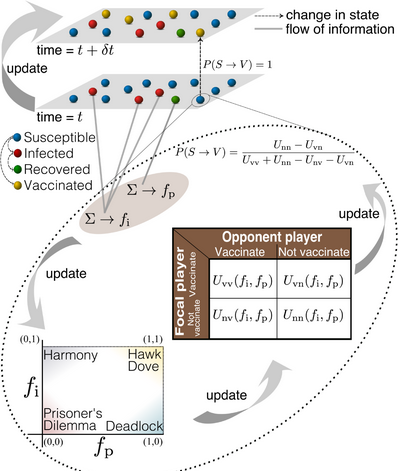
To understand the interaction between human behaviour and epidemic dynamics, this paper presents a model in which rational agents make strategic decisions to vaccinate themselves on the basis of information about the disease prevalence and the immune status of their neighbours in a social network. Each agent decides their action by playing a game against a hypothetical opponent who shares the same neighbourhood. In this model, the payoffs defining the structure of the game incorporate real-time information on the specific situation prevailing in the network neighbourhood and consequently vary dynamically amongst individuals. Thus, the games played by the different agents change over time with the spread of the disease across the network, resulting in an emergent spatio-temporal heterogeneity in the nature of the games. The researchers find that this heterogeneity at the level of individual agents, in terms of both information available to them as well as their response, can have significant implications for population-level outcomes such as the final epidemic size and the extent of vaccine coverage.
Specifically, as an epidemic propagates through the population, each agent can have access to local information about the number of infected cases among her network neighbours (i.e., with whom she has direct contact), as well as global information about the disease prevalence in the entire network. Such information is obtained through different channels, e.g., via mass media in the case of global information and through word of mouth for local information. The agents also have information about the extent to which their neighbourhood offers them protection from the disease. This is provided by their knowledge of how many of their neighbours are immune as a result of either having recovered from the disease earlier, or through vaccination. Each agent uses this information to determine their likelihood of getting infected. Based on this threat perception, the agents subsequently make a strategic decision on whether to get vaccinated by taking into account the "cost" associated with vaccination. This cost arises from the threat of side effects, either real or perceived, as well as the effort involved in getting vaccinated, and it tempts the agent to free-ride on the protection that may be offered by the immunity of their neighbours, particularly when the prevalence is low. If every agent argues along the same lines, it will lead to extremely low vaccine uptake, causing the loss of herd immunity and exposing the population to the risk of an epidemic outbreak of a VPD.
A simulation of the model shows results for the co-evolution of epidemic spreading and vaccine uptake behaviour in the largest connected component of a social network in a village of southern India.
One finding of the modeling (explored in depth in the article) is that a defining factor for efficient disease control through voluntary vaccination is the source of information. Faster and more efficient vaccine coverage is observed for the case when individuals assess their risk of catching infection based on the prevalence in the local social network neighbourhood, as opposed to that in the whole population of their social network. Compared to the size of the entire population, the number of cases that are reported in the initial phase of an epidemic is fairly low, and, therefore, an individual who only has access to the global prevalence information may not perceive the disease to be a serious threat. Consequently, the perception of risk in contracting the disease takes some time to become significant enough to incite vaccine uptake among individuals. However, by the time global prevalence becomes high enough so that the perceived risk of infection outweighs the cost of vaccination, the epidemic will have already affected a large fraction of the population.
The implications of the results reported here suggest that access to real-time information about the state of an evolving epidemic can change the risk perception and affect the vaccine uptake decisions made by individuals. These in turn result in emergent patterns of collective choice behaviour that may provide insights into the mechanisms driving vaccine acceptance, which could be relevant for public health planning. The key outcome for such planning is that accurate and localised reporting of disease outbreak is crucial for changing individuals' risk perception and thereby their attitude towards vaccination, especially during the initial phase of an epidemic.
PLoS Computational Biology 15(5):e1006977. https://doi.org/10.1371/journal.pcbi.1006977
- Log in to post comments