










































Comparing Inductive and Deductive Analysis Techniques to Understand Health Service Implementation Problems: A Case Study of Childhood Vaccination Barriers
The University of Sydney (Bonner, Costa, Trevena); Murdoch Children's Research Institute (Tuckerman, Kaufman, Danchin); Royal North Shore Hospital (Costa); University of Newcastle (Thomas); University of Melbourne (Danchin); The Royal Children's Hospital (Durrheim, Danchin)
"A deductive analysis technique using theory-driven constructs may identify different implementation issues compared to inductive techniques that are data-driven."
Multiple theories are used in health care, from simple models of individual health behaviour change like the Theory of Planned Behaviour (TPB) to broader systems-thinking approaches. The Behaviour Change Wheel (BCW) is one approach that attempts to bring individual and system level factors together, based on the COM-B (capability, opportunity, motivation-behaviour) framework, which synthesises 14 behavioural constructs in the Theoretical Domains Framework (TDF) into broader categories. This study compares inductive and deductive analysis techniques in addressing childhood vaccination, an implementation issue with wide-ranging barriers contributing to low-vaccine uptake internationally.
This analysis is based on data gathered for the Vaccine Barriers Assessment Tool (VBAT) project, which aims to design and validate a survey tool to diagnose the causes of under-vaccination in children under 5 years. The researchers conducted an overview of systematic reviews of primary studies, and 583 descriptions of parental barriers to childhood vaccination uptake (from the perspective or parents) were extracted and inductively grouped into categories. In a separate deductive process, the 583 barrier descriptions were mapped to the 14-domain version of the TDF to ensure that a comprehensive pool of potential survey questions could be generated that captured both access and psychological or acceptance barriers.
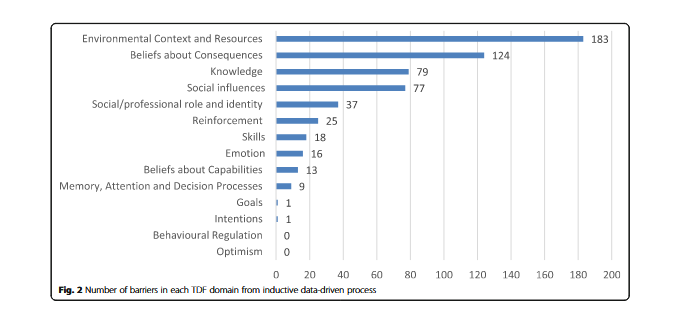
The inductive process coded 583 descriptions of barriers identified from the literature into a framework of 74 barriers in 7 categories. The initial definitions used to map the barriers to deductive domains/constructs led to 89% agreement at the domain level. Resolving discrepancies required further definitions at the construct level. Of the 14 TDF domains, 10 were clearly identified in the data from the barrier reviews. Some domains were not specific enough to differentiate between types of barriers (e.g., Environmental Context and Resources), while other domains were not represented in the review data (i.e., Optimism, Intentions, Goals, and Behavioural Regulation).
The researchers describe this process, which involved both inductive and deductive analysis techniques, as useful to gain a comprehensive understanding of the barriers to childhood vaccination. The inductive data-driven categories represented the primary research data in a clearer way than the deductive theoretical domains, with better differentiation, but the four missing theoretical domains helped identify key gaps to be addressed in the development of a new tool to diagnose the causes of childhood under-vaccination. The decisions made at construct level were arguably more subjective than the domain level, but both needed to be considered to make sense of many barriers that could be framed in different ways.
Practical implications for other researchers seeking to understand implementation barriers using theoretical frameworks in this way include:
- Researchers need to decide on very specific framing for a health situation. In this case, the researchers only considered the parent perspective on vaccinating their child, which determined how they framed barriers relating to the doctors' knowledge. Conducting this process from the health professional perspective would produce different results.
- The COM-B framework was not specific enough, so researchers may need to go into more detail at domain and construct levels to interpret the data.
- The value of using deductive theory-driven analysis techniques may depend on available resources, given this process took 2 authors with prior knowledge of behavioural frameworks approximately 2 weeks for coding and discussion.
The researchers also review the study's theoretical implications. For instance, some constructs are vague and became catchalls, such as barriers and facilitators. Others are too specific and hard to distinguish, particularly group vs. social norms, which could be combined into one category. The researchers recommend a hybrid approach combining TDF with broader frameworks for future researchers conducting evidence syntheses.
In conclusion: "Using both inductive and deductive analysis techniques can help achieve a more comprehensive understanding of barriers to health service implementation....Both analysis techniques resulted in a comprehensive list of barriers to vaccination that would not have been achieved using either approach alone."
Implementation Science Communications volume 2, number 100 (2021). https://doi.org/10.1186/s43058-021-00202-0.
- Log in to post comments