










































An Embedded Implementation Research Initiative to Tackle Service Delivery Bottlenecks in the Expanded Programme on Immunisation in Pakistan: Overview and Reflections
United Nations Children's Fund (UNICEF) New York (Shahabuddin, Sharkey, Duncan, Jackson, Peterson); World Health Organization (WHO) Regional Office for Eastern Mediterranean (Khalid); wHO Phnom Penh (Rasanathan); UNICEF Regional Office for South Asia, Kathmandu (Hasman, Farrukh, Rutter); WHO Geneva (Tran, Ghaffar); UNICEF Country Office, Islamabad (Durrani, Ahmed); UNICEF Country Office, Sanaa (Ongwae); London School of Hygiene and Tropical Medicine (Jackson); Ministry of National Health Services, Regulations & Coordination, Islamabad (Hafeez)
"I always thought that research is for academics...being involved in this study right from identifying a relevant research question to synthesizing findings for policy makers, I am finding the research useful for me too..." – EPI implementer (vaccinator)
Embedded implementation research (IR) involves tackling a programme's systems and implementation bottlenecks of a programme by getting implementer and policymaker buy-in through direct engagement. To address Pakistan's low immunisation rates and persistent coverage disparities within the country, in 2016, the Government of Pakistan, the United Nations Children's Fund (UNICEF), and the Alliance for Health Policy and Systems Research (AHPSR) launched the Embedded IR for Immunisation Initiative with the financial support of Gavi, the Vaccine Alliance. The goal was to explore health systems and implementation bottlenecks - and potential strategies to tackle such bottlenecks - in the Expanded Programme on Immunisation (EPI) in Pakistan. This paper provides an overview of the initiative's approach and key learnings to inform future embedded IR initiatives.
The initiative followed several steps, starting with a desk review to compile existing data and information on key implementation challenges. Following this, a research prioritisation workshop involving EPI managers and in-country researchers was held in February 2017 to prioritise topics for research, and a call for proposals was subsequently made. From 36 submissions, 10 research teams were selected for funding. IR thematic areas/topics included: community and demand (i.e., involvement of community health workers to improve immunisation coverage in hard-to-reach areas of Sukkhur district, addressing community barriers to immunisation in Rajanpur district, addressing EPI vaccination demand through mHealth in Quetta City, Balochistan, and a social mobilisation campaign to tackle immunisation hesitancy in Sargodha and Khushab districts); immunisation supply chain and performance management systems; human resources and service delivery; and building on the polio experience (e.g., developing a three-dimensional narrative to counter polio vaccine refusal in Charsadda). All projects were completed - culminating in a dissemination workshop where research teams shared their IR results with policymakers and implementers - within a nine-month time period.
Data were collected from members of the IR teams through an online survey and in-depth interviews with IR team members to explore further the challenges they faced while conducting IR in Pakistan and recommendations for future IR initiatives.
Key factors that facilitated the successful and timely completion of the IR studies included: appreciation by and leadership of implementers in generation and use of local knowledge, identification of research priorities jointly by EPI managers and researchers, and provision of continuous and high-quality support from in-country research partners. Of note: "This experience revealed how vital support and appreciation by the highest authorities within a system is to ensure the acceptance by and involvement of relevant stakeholders, and the successful implementation of a program. In Pakistan, leadership of the Federal Ministry of Health was instrumental to acceptance of the Initiative by all stakeholders....Additional evidence suggests that stakeholders’ ownership of the research is increased when they are involved in projects from the outset or lead the process..."
Challenges included a lack of clarity on the role and responsibilities of each partner involved and need for further support to facilitate use and dissemination of research findings. For instance, research teams stressed the need to organise more sub-national dissemination activities (e.g., roundtables) to share clear and specific recommendations with provincial- and district-level EPI policymakers.
Reflecting on the findings, the researchers note that, "in a decentralized health system such as Pakistan's, it is important that communication, and dissemination of discrete and specific recommendations should be done with policy makers at the appropriate levels at which decisions can be made. Engagement of communities to explore their roles in implementing new solutions can also be critical. Building researchers, policy makers' and programme managers' capacity to foster research utilisation, working with strong advocates or policy champions, and having the support of a coordination body in the country have been found to improve uptake of IR findings and recommendations into EPI policies and practices..."
Specific suggestions for future embedded IR initiatives include identifying and developing an implementation strategy (including a clear delineation of roles and responsibilities, as well as dissemination and communication of recommendations) prior to the start of research. Moreover, a dedicated strategy or guideline can ensure effective coordination among all partners involved and ensure that each of the partners do their job as planned.
In conclusion, this experience demonstrates that "an immunisation programme in a lower middle-income country can use small and time-bound embedded IR, based on partnerships between programme managers and local researchers, to generate information and evidence that can inform decision-making."
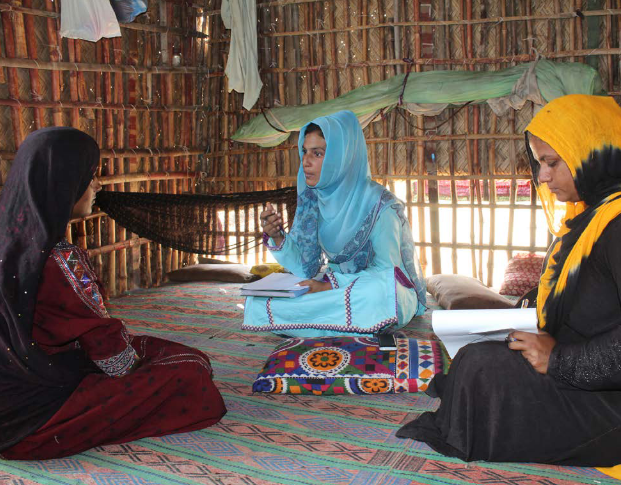
Journal of Global Health. 2021; 11: 06003. doi: 10.7189/jogh.11.06003. Image credit: © VITAL Pakistan Trust/Danish Ali
- Log in to post comments