










































Report: Stakeholder Meeting for Vaccine Safety Communication
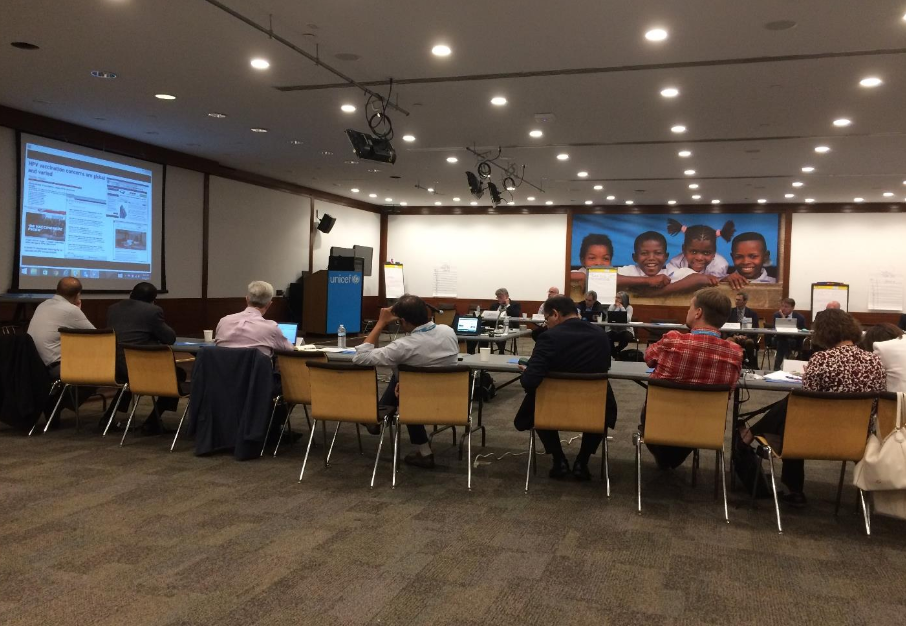
"Useful suggestions and recommendations were provided that can guide the development of vaccine safety communication frameworks for strategy formulation, including tools, strategies and mechanisms for communication and partner coordination."
The United Nations Children's Fund (UNICEF) and the World Health Organization (WHO) have been working closely with Gavi, the Vaccine Alliance, the United States (US) Centers for Disease Control and Prevention (CDC), and other partners on building and maintaining public trust in vaccine safety. As part of that work, UNICEF and WHO hosted a stakeholders' meeting on vaccine safety communication in September 2017 in New York, US. The aim was to consult international vaccine safety experts, as well as communication and social media specialists, to identify gaps in management of vaccine safety communication, to explore new opportunities using current information platforms, and to make plans to promote effective vaccine safety communication through the next resources to be developed.
The report summarises the proceedings, culling out central themes. In brief, on Day 1, Stefan Peterson, UNICEF Chief of Health, Robin Nandy, UNICEF Chief of Immunization, and Patrick Zuber on behalf of WHO shared opening remarks in relation to strategic communication and messaging on vaccine safety. Heidi Larson, Director of the Vaccine Confidence Project at the London School of Hygiene and Tropical Medicine, shed light on the global trust environment, setting the stage for subsequent sessions, including:
- global perspectives and agency updates on vaccine safety communication by WHO, UNICEF, and the CDC;
- understanding and leveraging the latest evidence on engaging vaccination skeptics and critics (on this topic, speaker John Parrish-Sprowl, Director, Global Health Communication Center, Indiana University - Purdue University, gave an overview of what counts as evidence in vaccine safety communication and why this matters. He emphasised that how we communicate is often more important than the content of the messages and introduced the notion of communications as a bioactive process that enables mutual reactivity or receptivity); and
- challenges and opportunities for digital dialogue, moderated by Galit Gun, UNICEF Social Media Specialist, with various speakers weighing in.
Informed by the day's presentations, participants attended breakout sessions and presented outputs under 4 thematic areas: 1) communication approaches and strategies at global, regional, and country levels; 2) web analytics and social networks; 3) community engagement and capacity building of frontline workers; and 4) partner coordination.
Day 2 featured discussions, experience sharing, and feedback sessions on regional perspectives in vaccine safety communication, and challenges and solutions in the context of recent adverse events following immunisation (AEFIs). Participants noted the following constraints: 1) the inadequate provision of funding and incentives to scale up and mainstream interpersonal communication (IPC) skills and tools in health worker immunisation activities, especially to scale up community engagement activities; 2) lack of coordinated efforts in regard to listening to and engaging in digital dialogue; and 3) the absence of a mechanism for the global communication coordination of programmes that build and maintain public confidence in vaccines.
Detailed discussion focused on next steps (areas for investment), organised under the following 5 themes:
- The need for a safety communication framework to identify safety communication scenarios and propose common principles to address specific situations. The meeting recommended the following key interventions for advancing strategic thinking and planning: the provision of a joint global vaccine safety communication framework and action plan to guide the communication approaches, interventions at all levels, establishment of coordination mechanisms, and progress sharing; clear roles and accountabilities for risk, outbreak, and crisis communication; institution of a regular learning exercise between partners and countries; establishment of a coordinated system for measuring and tracking vaccine trust and confidence; and in-country capacity building.
- A common messaging of vaccine safety issues for global partners. The compilation of case studies was suggested as an initial step towards learning how messaging evolved and messages were adapted for different contexts and events. Participants also proposed drafting a framework to guide message and content development that links scenarios to audiences, content, messages, and materials.
- The sharing of existing communication resource materials through an e-library. On the related matter of web analytics and social networking, participants suggested focusing on: (i) using data from social media and the web to capture signals that may require communication interventions and to better understand the information needs of the public; (ii) engaging in digital dialogue and mediating between different positions; (iii) "pre-bunking" (vs. debunking) by identifying pre-bunking champions, developing proactive pre-bunking content, and devising effective approaches to delivering content with accurate audience targeting; and (iv) sharing robust monitoring and analysis of content at a global level across the broad spectrum of media and social networks.
- The development of quality standards for planning and implementing vaccine safety communication. It was suggested that greater documentation that captures learning and experiences on a regular basis is needed to help mobilise effective planning and interventions in this area. Participants also recommended consulting and agreeing on criteria for establishing and abiding by vaccine safety communication quality standards.
- A focus on partner coordination. Participants suggested the need for: (i) investment in the development and use of joint efforts to foster collaboration and coordination (vertical and horizontal); and (ii) branding of general benefits of vaccines while also promoting public trust in vaccine safety/effectiveness, which can serve as the basis for fostering partner collaboration and coordination.
The meeting ended with concluding remarks by Robin Nandy, UNICEF Chief of Immunization.
Global Vaccine Safety website, June 22 2018.
- Log in to post comments