










































Use of Social Data and Evidence in Polio Eradication Programme
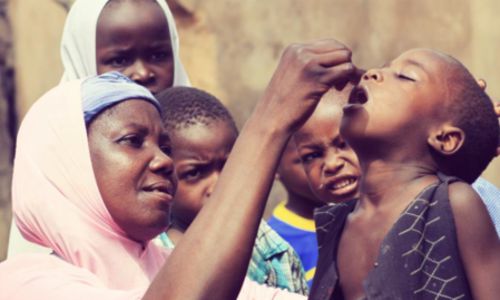
United Nations Children's Fund (UNICEF)
The United Nations Children's Fund (UNICEF) is one of the partners in the Global Polio Eradication Initiative (GPEI). In this presentation, UNICEF's Senior Communication Manager, Rustam Haydarov, explores the role of social data in the context of current GPEI priorities and in the overall quest to eradicate polio worldwide.
An initial slide looks at the polio communication focus through the years, starting from an effort to convert refusals (change the mind of those refusing to vaccinate their children with the oral polio vaccine, or OPV) and adding an effort to vaccinate all missed children, work on building trust, and mitigation of vulnerabilities and risk. Haydarov stresses that vaccine acceptance is not a steady state; hesitation can endanger success, and high vaccination rates belie social fragility. There is a continuum running from those who vaccine refusal, to vaccine hesitancy, to passive acceptance, to active demand (the "finish line"). Threats to reaching the latter include campaign fatigue, belief that polio is curable, negative rumours, belief that giving OPV is not socially acceptable, and conviction that OPV is not a priority in the absence of cases.
Haydarov stresses that the health system and community need to work together to generate success. The healthworker needs to have a culturally appropriate profile and to be knowledgeable, compassionate, communicative, and motivated. The caregiver needs to be informed, aware, motivated, and receptive to service. Stockouts of vaccine inhibit demand, and caregiver experience at the point of service can positively or negatively influence demand. Put another way, there is a supply piece - systems ensure quality health services and frontline workers (FLWs), as vaccines are available, potent, in right quantity, and managed appropriately - and demand piece: Caregivers and communities seek, support, and advocate for services.
Both quantitative (e.g., knowledge, attitudes, and practices (KAP) surveys) and qualitative (e.g., media studies) data are available to support the goal of immunising all children. Periodic campaign data include:
- Independent monitoring (IM) data (mostly standardised) that hone in on: campaign awareness, sources of information; missed children tracking; and refusals, absent, child asleep, newborn
- Social mobilisation data (vary by countries) that focus on: catch-up: refusal conversion, recovery of absent children; routine immunisation coverage (registry); guest and visiting children; and social mapping of mobile population, influencers, transit points.
Haydarov encourages shifting outside of the "comfort zone", asking questions like: Are periodic IM data sufficient to inform communication decisions to identify consistently missed children? Are there other opportunities to engage full-time social mobilisation networks in periodic data collection and "soft knowledge" generation? Are existing data being used to their full potential?
UNICEF carried out formative polio KAP studies in collaboration with Harvard Opinion Research Program (HORP), 2013-2017, in Nigeria, Democratic Republic of the Congo (DRC), Uganda, Somalia, Afghanistan, Pakistan, and India. Strengths included: reliable social data, application to communication for development (C4D), responsiveness, credibility, and impact. Challenges included: cost, time and effort, and sustainability.
In Afghanistan, the data are being used to address rumours:
- "Da pula poray" ("On the Border" in pashto) is a radio soap opera using targeted messages based on KAP data with content on combating rumours. The storyline features a female social mobiliser talking about the daily challenges she is facing related to misinformation that threatens her community. The 30-minute format includes 7 minutes of facts, news, and interviews, featuring real people from Pashto the community. Running for 10 years, it has reached 25% of the Pashto audience in polio areas.
- BBC Media Action's "Ghamai" is a child health show for a Pashto audience featuring human interest stories of polio survivors, as well as interviews with mullahs, doctors, and community leaders. The popular call-in show with a doctor features discussion content driven by the first KAP. Its audience is about 30% of the Pashto community; running at the same time as "Da pula poray" on weeknights, the total estimated coverage is 60% of the Pashto audience.
In Pakistan, the data are being used to shape the "Sehat Muhafiz" approach to building trust, integrating communications with the overall programme operations. Adoping a localised approach has involved ensuring Sehat Muhafiz/government branding of the programme (debranding in media/public relations (PR) materials of any donor or agency branding). The "Strangers No More" campaign of 2016-2017 centred around the portrayal of vaccinators as being local - from the community - and respectful, knowledgeable, and committed. There has also been a focus on the frontline workforce, involving hiring of local and female vaccinators/FLWs (countrywide, approximately 61% female team members). Emphasis has been placed on interpersonal communication (IPC) by FLWs and influencers. Finally, there has been an all-society approach across political/social lines, with 12,000 print and electronic stories in English, Urdu, and regional languages featuring an overwhelming positive and neutral media tonality; this has shaped social norms and perceptions in the public sphere.
Haydarov stresses that qualitative insights are as important as qualitative ones; he uses quotes from research studies undertaken by UNICEF Pakistan to go, first, "inside a caregiver's brain" and then, second, "inside a vaccinator's brain. These quotes illustrates how fatigue/frustration, family and community norms, and perception of social support can impact immunisation decisions (refusals) and motivation (on the part of FLWs).
Work (2015) by Anthrologica and UNICEF Somalia on polio vaccination in Somalia sheds light on the beliefs, values, and health-seeking behaviour of nomadic and pastoralist communities, where a proverb holds, "A sick man is advised by a hundred". The process of illness only results in seeking treatment from a biomedical doctor when other care options fail. Understanding what matters in this context would be important in knowing how to approach mobile populations with polio communication messages.
In addition to data about mobile and inaccessible populations, social research gaps include:
- Health worker motivation and caregiver values
- Barriers to recruiting female team members - appreciating the complexity
- Rapid and sound methodologies for data collection in conflict zones, complex emergencies, and outbreak settings
- Emerging issues - "knocks on the door", campaign fatigue, vaccine hesitancy
Haydarov lays out a way forward that includes: (i) building capacity by supporting high-risk countries with targeted and actionable social research strategies; (ii) supporting advocacy by maintaining social data as critical element in achieving high coverage; and (iii) developing global guidance: detailing qualitative approaches (mobile populations, FLWs - anthropological focus); creating a KAP management manual for C4D managers based on the Harvard experience; and providing social data for complex security and outbreak contexts. Rhizome by GPEI is a polio C4D portal featuring proven strategies, tools, products, and training for enabling vaccination environments.
Editor's note: The above is a summary of a presentation delivered by Rustam Haydarov at Shifting Norms, Changing Behaviour, Amplifying Voice: What Works? The 2018 International Social and Behavior Change Communication (SBCC) Summit featuring Entertainment Education, held April 16-20 2018 in Nusa Dua, Indonesia.
Email from Rustam Haydarov to The Communication Initiative on May 15 2018. Image credit: UNICEF
- Log in to post comments