










































"What Is the Problem with Vaccines?" A Typology of Religious Vaccine Skepticism
"[I]t is imperative to consider the impact of religion in light of other factors, such as politics (both national and international), history (eg, colonialism), and cultural values (eg, gender roles). The relationship between religion and vaccine hesitancy is, in other words, complex and context specific."
Research has identified religion as one of numerous factors that may contribute to delay or refusal of vaccination. However, there was no direct link between a particular faith type and vaccine response, as can be exemplified by the strong resistance towards polio vaccination by Muslims in Nigeria, Pakistan, and Afghanistan contrasted with the Muslim nation of Saudi Arabia, which had the lowest religious objection rate in one survey. To shed light on how religion influences vaccine decisions in practice, this article offers a typology of religious vaccine skepticism (RVS) with the aim of capturing and describing the essence of the various religious objections and clarifying the relationship between them.
RVS here denotes an attitude of doubt or disbelief towards vaccines that originates in, is related to, or is explained as religion. The typology presented in this article deals with skepticism that is somehow related to religion. Other aspects of religion that may contribute to vaccine hesitancy are not included. Even when religion does hinder immunisation, this impact may be accidental and not related to skepticism, as when participation in a religious celebration is prioritised over a visit to the clinic. For policymakers and public health workers, it is imperative to know when the solutions to counter vaccine hesitancy are found outside religion - e.g., simply rescheduling the appointment.
Notably, reducing RVS to a question of religious doctrines often offers little help in practice. Often, one particular doctrine is interpreted differently by different groups, as in the case of the religious duty to preserve life. Consequently, the very same doctrine may be relied on by both acceptors and rejectors of a vaccine.
The typology was developed within the academic discipline of the study of religion. The included articles were peer-reviewed, written in English, from different fields (predominantly health sciences and social sciences), and of various kinds (case studies, meta-analyses, systematic reviews, situation analyses). Although religion was not necessarily their primary focus, their findings involved significant religious arguments against vaccination. The types were structured according to the essence of what is considered problematic with vaccines from the perspective of a religious individual or group, that is, as answers to the question, "What is the problem with vaccines?" The essence captured in each type may hence span across religious traditions and groups.
The typology consists of 5 main types:
- Vaccines are irrelevant or destructive (worldview clash type): The perception of polio by the Hausa communities in northern Nigeria may serve as an example. Known as cutar shan-Inna, polio is believed to be a result of a powerful spirit (Inna) drinking the blood of the victim's limb. Healing may come from offering the spirit whatever she informs the traditional healer that she wants in return for the limb (e.g., food), accompanied by prayer, incense, and herbal massage. If healing does not occur, it means that the spirit was not satisfied. Within this scenario, the oral polio vaccine (OPV) - "a few drops of liquid in a [healthy] child's mouth" - makes very little sense.
- Vaccines interfere with God's will or reveal distrust (divine will type): In the worldview clash type, people's chosen course of action is believed to prevent or induce a particular outcome. In contrast, the divine will type describes the passive acceptance of an outcome that is believed to be decided by God, be it health or disease, life or death. Since God determines the result, it is considered useless or even sinful to try to prevent it. However, fatalistic beliefs do not always lead to vaccine hesitancy. To illustrate, most Muslims believe diseases occur by God's will, yet Muslims often accept vaccines as part of their duty to protect their health.
- Some vaccines are unethical (immorality type): The value judgment of these vaccines is either referring to the production of the vaccine (cause-related subtype) or believed to result from the use of the vaccine (effect-related subtype). An example of the former: Reports from 19th century India recount that many Hindus objected to smallpox immunisation because of its involvement of cows, which are believed to be sacred. An example of the latter: The fear of social stigma if one is perceived to need human papillomavirus (HPV) vaccines may cause hesitancy in cultures where sexual abstinence before marriage is the norm.
- Vaccines defile the human body (impurity type): Oigs, for instance, are regarded as unclean by Muslims, Jews, and some Christians, such as Seventh Day-Adventists. Several studies have pointed out that to many Muslims, porcine ingredients, like gelatin and trypsin, are major concerns and barriers to immunisation that can only be solved by halal certification, or proof that the vaccine does not contain prohibited ingredients.
- Vaccines are used to harm us (conspiracy type): The complexity of this type can be illustrated by the boycott of the OPV by some of the Muslim-majority states in northern Nigeria in 2003. On the surface, this could resemble a classic religious conspiracy theory with local political and religious leaders warning that the polio vaccine had been deliberately contaminated with anti-fertility agents and HIV viruses as part of a Western plot to reduce Muslim populations worldwide. As has later been pointed out in several in-depth analyses, the conspiracy accusations were only a small piece of a larger and much more complex political picture.
This typology could be helpful for policymakers and public health workers, as different types require different interventions. For example, neither arguments nor alternative vaccines are likely to solve problems arising from the conspiracy type. Here, the building of trust is key - a measure that, in turn, would have little impact on the worldview clash and divine will types. Per the researcher: "Bearing in mind that the influence of religion on people's vaccine decisions is highly complex and context dependent, the exact impact of various interventions are topics for future studies....Further, the extent to which a certain belief results in vaccine rejection should be examined. To different people, the same belief can result in different vaccine decisions, and it can be helpful to discern what other factors influence the result."
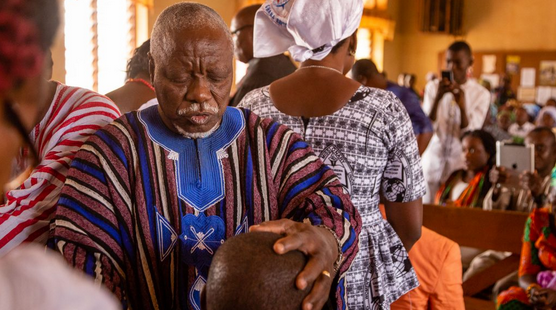
Vaccine: X. Volume 14, August 2023, 100349. https://doi.org/10.1016/j.jvacx.2023.100349. Image caption/credit: The Taraana prays over his fellow deacons during their ordination at First Baptist Church, Nalerigu, Ghana. William Haun
- Log in to post comments