










































Factors Influencing the Implementation of Global Polio Eradication Initiative in Low- and Middle-Income Countries: A Qualitative Evidence Synthesis
Vom Christian Hospital (Mshelia); University of Sheffield (Blackmore, Archer, Booth)
"Polio eradication programmes depend, for their success, on the engagement and synergistic action of multiple stakeholders."
While the incidence of polio has been reduced by 99% through the Global Polio Eradication Initiative (GPEI), the World Health Organization (WHO) has suggested that even a single case of polio anywhere in the world is a global health risk. By providing evidence on the factors (barriers and facilitators) influencing the implementation of the GPEI in low- and middle-income countries (LMICs), this qualitative evidence synthesis (QES) seeks to contribute to ongoing efforts to eradicate the remaining 1% of polio cases by informing the development of a framework that policymakers can use to explore factors specific to their geographical and population-based context.
Through a process detailed in the article, the researchers reviewed 11 qualitative research or mixed methods study reports published between 2012 and 2017. (The characteristics of each study are documented in Table 1 in the paper). Highlights:
- Four studies were conducted in Nigeria, 3 in Pakistan, 2 in Ethiopia, and one each in Angola and Cameroon.
- Three studies explored multiple perspectives of health workers, community and religious leaders, and stakeholders. Six studies had caregivers including parents as participants, while 2 studies had health workers as participants. Stakeholders such as policymakers, programme managers, social mobilisation officers/health educators, and representatives were involved in one study.
- Three of the studies used focus group discussions (FGDs), while 4 used in-depth interviews (IDIs); the remaining 4 used both FGDs and IDIs. Participant observation was conducted in 2 studies.
The researchers extracted qualitative research data and assessed study quality using the Critical Appraisal Skills Programme (CASP) qualitative checklist (3 studies were assessed as high quality, 5 as medium quality, and 3 as low quality). They then conducted best-fit framework synthesis to organise, and explore patterns in, the data, which they report here - organised by theme. (Table 3 provides a summary of the representation of main themes by the individual studies and synthesises the main themes and sub-themes.) In brief:
- Programme resources and logistics - e.g., one study found that awareness creation was key to the uptake of polio immunisation but was poorly implemented due to insufficient resources being allocated for campaigns. This led to an absence of information or parents feeling under time pressures to vaccinate their children. Other studies found that opportunities to disseminate messages about vaccination might include TV programmes or at the mosque after prayers.
- Technical aspects - e.g., one study found that the staff lacked skills - e.g., communication skills - to effectively carry out eradication activities, with lack of training as a contributing factor.
- Programme operation, management, and organisation - e.g., one study found that the government failed to take ownership of the programme because of overdependence on development partners. "When there is ownership, there is active involvement in vaccination activities..." Another study suggested that attitudes of health workers may impact upon the willingness to attend vaccination clinics: A few caregivers "described the impolite behaviour of health workers towards women with low levels of education, teenage mothers and mothers who arrived late or forgot their vaccination cards..."
- Monitoring, evaluation, and feedback - e.g., one study found that a lack of monitoring and supervision at the local level may affect the overall performance of the programme.
- Insecurity in high-risk polio areas - e.g., health workers in one study suggested that house-to-house visiting should be stopped and restricted to the health centres because of insecurity; this could be problematic, as people from rural areas may not be willing to go to health centres for immunisation.
- Vaccine acceptability by caregivers - key points:
- A common view among health workers in one study was that, "revisits [to the doorstep] create suspicion in the minds of parents, and that is why some believe it's an American campaign..."
- Some parents perceive that the "polio vaccine is prepared in the West and sent here. It is then given to our children in order to destroy their ability to reproduce in the future..."
- Illiteracy was identified by one study as a reason why parents refuse to accept the vaccine.
- Religion can be an important factor; a social mobiliser said, "There is a video tape being circulated by one Muslim teacher discouraging people against vaccination… and resulted in our vaccination teams...to be attacked..."
- Some study participants voiced doubts about the effectiveness of vaccines; others had concerns about vaccine side effects. One study found that, where health workers were indigenous to the community, this could help to address vaccine resistance. Another identified awareness raising and community engagement as helpful to improving vaccine uptake in resistant areas, particularly when traditional and religious leaders are involved in the mobilisation.
- Competing belief systems - 2 studies reported competing belief systems (such as the conviction that qur'anic verses can be recited to invoke divine protection against all diseases), which impact on decision-making processes regarding vaccination.
- Influence of community stakeholders - e.g., one study described attacks on health workers as a way of expressing displeasure with the government for lack of social amenities. Stakeholders, especially religious leaders, can also play a positive role in raising awareness, according to another study.
- The nature of the disease - e.g., one study found various ideas of the nature of the disease, including that it has a supernatural cause.
- Cross-border polio surveillance - e.g., one study suggested that immunisation cards should be used at the borders to check for unvaccinated children and also highlighted the importance of holding regular cross-border consultative meetings.
Gleaning implications for policy and practice from the findings, the researchers suggest that, "as anticipated by the socio-economic (ie, LMIC) context for this review, structural and infrastructure concerns figure prominently as a prerequisite to subsequent shaping of how best to deliver the services (Theme 1). Linked to this is the associated capacity-building issue of skills and training (Theme 2) together with human resource and political issues that impact on program operation and management (Theme 3). Completing the program cycle we identify issues that relate to monitoring and evaluation (Theme 4). Only after these organisational issues have been resolved can attention turn towards 'on the ground' concerns such as Insecurity (Theme 5) and Cross Border Surveillance (Theme 10), as well as to the belief systems engaged by Vaccine Acceptability (Theme 6), Religious and Traditional beliefs (Theme 7), Influence of Stakeholders (Theme 8) and Perceptions of the Disease itself (Theme 9)."
Among the implications for research: "Even within a relatively tightly specified sub-population, parental attitudes are heterogeneous and individual parental perspectives and preferences must be explored within the wider context of individual belief and value systems. More qualitative research is needed to shape a response that accommodates a wide range of individual responses and thus improve the extent of coverage of polio eradication programmes."
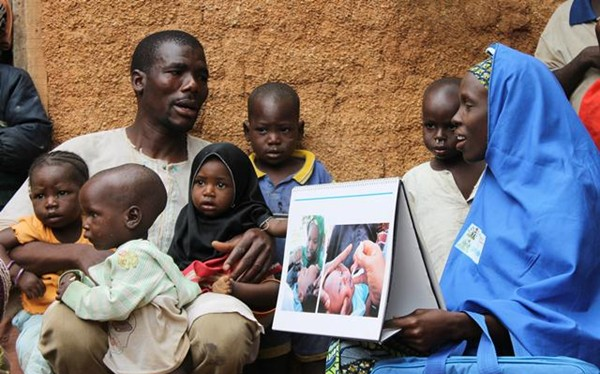
Journal of Global Health Reports. 2019;3:e2019073. doi:10.29392/joghr.3.e2019073. Image credit: "Binta, a Volunteer Community Mobilizer [in Nigeria], has convinced Sabiu to get his children immunized against polio" - United Nations Children's Fund (UNICEF)
- Log in to post comments