










































A Critical Review of Measures of Childhood Vaccine Confidence
University Health Network (Shapiro); Murdoch Children's Research Institute (Kaufman); La Trobe University (Kaufman); University of North Carolina (Brewer); The University of Sydney (Wiley, Leask); World Health Organization - WHO (Menning)
"This review highlighted that not all potentially relevant confidence constructs have been identified and included in previous measures of vaccine confidence or comprehensively investigated in large, representative, population-based studies."
Characterising the multiple reasons for low vaccination can enable direct comparisons among different factors and help guide the development, implementation, and monitoring of interventions to improve vaccination. An important aspect of this work is vaccine confidence monitoring, which should build on standardised and validated measures. As part of its work to develop tools for the assessment of the range of factors that influence children's vaccination across diverse global contexts, the World Health Organization (WHO) established the Measuring Behavioural and Social Drivers of Vaccination (BeSD) working group. (See Related Summaries, below.) The first stage of the BeSD work was to carry out a literature review aimed at identifying a comprehensive set of key measures of vaccine confidence. This article reports on the findings of that review.
Carried out in April 2019, the search identified 14 published measures of caregivers' confidence in childhood vaccination, all published between 2010 and early 2019 (see Table 1 in the article). The review excluded confidence measures for specific vaccines because the BeSD's planned Childhood Immunization Survey, which this review is meant to inform, is meant to be usable in many contexts and for many vaccines.
The 14 measures were all developed in high-income countries, except the Caregiver Vaccination Attitudes Scale, which was developed in Ghana, a middle-income country. Measures included 1-5 constructs each. The most common constructs were: beliefs in the benefits or importance of vaccination; trust in vaccines, healthcare providers, the scheduling of vaccines, and the legitimacy of authorities to require vaccination; vaccination harms; and perceived risks of infectious disease. The measures typically assessed each construct using 1-2 items.
For half the measures, the developers explicitly reported the use of theoretical or conceptual frameworks that informed the development of their tools. The BeSD working group found that developers of the measures used conceptually overlapping terms such as 'attitudes', 'beliefs', 'confidence', 'hesitancy', and 'acceptance' in ways that were often inconsistent and unclear. So, the BeSD working group adapted and proposed definitions of key terms, as shown in Table 2 of the paper.
The psychometric properties, including reliability and validity, of the 14 measures were examined in 29 studies. The BeSD working group notes that psychometric validation may be especially informative when adapting measures to other languages or for new populations. Overall, the BeSD working group holds that the field needs measures validated for use in multinational, multiregional, and multicultural contexts for an inclusive and equitable approach to measurement. Thus, the BeSD tools will be designed for global usability.
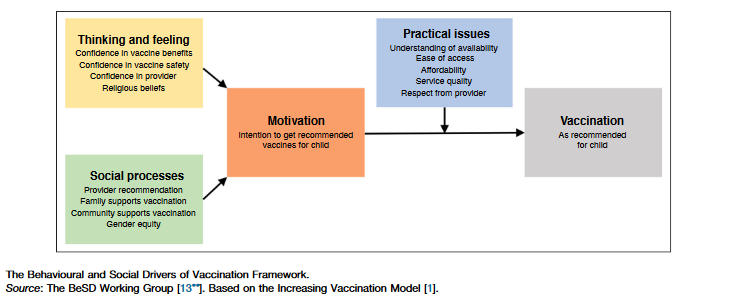
To address some of the shortcomings in existing measures, the BeSD working group developed a framework of vaccine uptake that includes what people think and feel, social processes, motivation, and practical issues (see image above):
- This framework presents beliefs and behaviour as distinct and separable constructs, with confidence belonging to the "thinking and feeling" domain.
- Social processes illuminate the gender barriers to vaccination such as travel and decision autonomy, as well as the role of healthcare provider recommendation. Social processes also include family and community norms.
- Motivation refers to the intention or hesitancy to receive recommended vaccines.
- Practical factors include awareness of when and where to get a vaccine and the number of vaccinations children should receive, ease of access to a clinic, opportunity costs, and clinic experiences such as respect from health workers towards caregivers.
Based on its analysis of existing measures, the WHO's BeSD tools will explore incorporating additional constructs relevant to vaccine confidence including, for example, compatibility of vaccination with religious beliefs and cultural practices, moral intuitions of purity (disgust in vaccination) and liberty, self-efficacy (belief in one's capability to receive a vaccine), and descriptive and subjective social norms. In addition to a quantitative survey, the BeSD tools will include qualitative childhood immunisation in-depth interview guides. (Editor's note: The tools have been developed and published as of 2022 and are available at Related Summaries, below.)
In conclusion: "Global demand is strong for a standardized, high-quality measure to understand the social and behavioral drivers of vaccination, including vaccine confidence. Our review of vaccine confidence measures and their psychometric validation can support the advancement of vaccination research and interventions to increase childhood vaccination."
Current Opinion in Immunology 2021, 71:34-45. https://doi.org/10.1016/j.coi.2021.04.002.
- Log in to post comments