










































Vaccine Hesitancy within the Muslim Community: Islamic Faith and Public Health Perspectives
Affiliation
United Arab Emirates University (Alsuwaidi, Hammad, Elbarazi, Sheek-Hussein); Loma Linda University (Sheek-Hussein); Harvard T.H. Chan School of Public Health (Sheek-Hussein)
Date
Summary
"Religious factors are distinct from other factors in that they are generally linked to core beliefs, which makes it extremely difficult to convince individuals to change their views on immunization..."
Vaccine hesitancy is a growing public health concern that has fueled the resurgence of vaccine-preventable diseases in several Muslim-majority countries. Although multiple factors are associated with vaccine hesitancy, certain religious deliberations are significant in determining individuals' vaccine-related decisions and attitudes. This review article summarises the literature on religious factors linked to vaccine hesitancy among Muslims, discusses the Islamic law (sharia) viewpoint on vaccination, and offers recommendations to address vaccine hesitancy in Muslim communities.
There are numerous studies on vaccine hesitancy and under-vaccination in Muslim communities. Brief examples from a few of the countries discussed include:
However, it seems clear that, in the context of Muslim communities, collaborations among political, public health, and religious leaders are key. For example, in Muslim communities that have witnessed anti-Western sentiments, engaging religious community leaders in the immunisation programmes with "inclusive ownership" has been suggested as a strategy to ameliorate vaccine refusal and enhance vaccine uptake. This strategy was found useful in the Mewat district of Haryana, India, where poor vaccine coverage has been a longstanding issue. Trusted religious leaders were engaged in co-designing communication interventions that involved broadcasting videos to disseminate advice and personal stories regarding vaccines. This intervention reportedly provided a platform for vaccine-positive messages among community members and increased vaccine confidence.
In conclusion: "Understanding the core Islamic beliefs pertaining to vaccination is critical for public health officials when dealing with issues of vaccine hesitancy and vaccine refusal among Muslims. Moreover, religious leaders must be engaged in decision-making regarding immunization programs, as their influence is effective in mitigating vaccine hesitancy and improving the community uptake of vaccinations."
Vaccine hesitancy is a growing public health concern that has fueled the resurgence of vaccine-preventable diseases in several Muslim-majority countries. Although multiple factors are associated with vaccine hesitancy, certain religious deliberations are significant in determining individuals' vaccine-related decisions and attitudes. This review article summarises the literature on religious factors linked to vaccine hesitancy among Muslims, discusses the Islamic law (sharia) viewpoint on vaccination, and offers recommendations to address vaccine hesitancy in Muslim communities.
There are numerous studies on vaccine hesitancy and under-vaccination in Muslim communities. Brief examples from a few of the countries discussed include:
- Indonesia - The coverage of childhood vaccines is suboptimal, which resulted in a massive diphtheria outbreak in 2017. In 2018, a fatwa (i.e., a formal ruling by a religious authority) issued by Indonesian Islamic clerics declared measles and rubella vaccine forbidden (Haram) under sharia because pig components were used to manufacture it. Consequently, immunisation rates have significantly dropped, reaching as low as 8% in Aceh, a province ruled by sharia.
- Pakistan - In this country, which has the second-largest Muslim population worldwide and ranks third globally for the most under-vaccinated children, "anti-vaccination" sentiments have rapidly spread in the Pakistani Muslim community, which claims that vaccination is a Western conspiracy to eradicate Muslims.
- Malaysia - Religious health fatalism (the belief that health outcomes are inevitable and/or determined by God) has been shown to influence health behaviours, including vaccination.
- Sudan - Immunisation officers and vaccine providers who were interviewed to better understand measles vaccine hesitancy in Khartoum state indicated “anti-vaccination” sentiments originating from religious groups, especially the Ansar Al-Sunna group, who often refuse all vaccines. In addition, a fatwa about prohibiting the vaccination of children was issued in 2007 by the leader of Sudan's Muslim Brotherhood claiming that vaccines are a conspiracy of Jews and Freemasons.
- United States - A survey conducted in March 2021 to explore COVID-19 vaccine uptake and hesitancy found that one cited reason for vaccine hesitancy among American Muslims was institutional religion-based discrimination faced by Muslims within the healthcare system.
- Australia - A qualitative study that explored human papillomavirus (HPV) vaccine knowledge, attitudes, and practices of parents from Arabic Muslim backgrounds found that a few parents were shocked to learn that HPV vaccine protects against sexually transmitted infections, considered this in conflict with their religious beliefs, and declined the HPV vaccine for their children.
- United Kingdom (UK) - People from certain ethnic minority backgrounds, such as Muslims from Bangladesh and Pakistan, were thought to be more reluctant toward COVID-19 vaccination because they did not want to invalidate their fast by taking vaccine during the fasting hours. A statement that COVID-19 vaccine does not invalidate fasting during Ramadan was issued by the President of the Two Holy Mosques in Saudi Arabia in March 2021; similar statements have been issued by other authorities, including the British Islamic Medical Association. This example emphasises the key role of religious and medical/health leaders in fostering the acceptance of their communities toward vaccination.
- Vaccination in the context of destiny and fate: An explicit question was posed to the Prophet Mohammad, peace be upon him (PBUH): "Should we take medication?" Based on the Prophet's reply, Islamic scholars consider vaccination a religious obligation. It is noteworthy that the Prophet (PBUH) emphasised the principle of social responsibility by preventing and guarding against the spread of epidemics.
- The viewpoint forbidding vaccination for children and adults: Fatwas by religious scholars have been observed in Pakistan, Afghanistan, and Malaysia prohibiting vaccinations for adults and children. These viewpoints are based on statements such as that the constituents of a vaccine contain forbidden and impure substances derived from pigs. These viewpoints can be refuted through arguments presented here (e.g., impure materials used in vaccines are permissible by means of istihala).
- The issue of the state compelling children and adults to be vaccinated: One of the purposes of Islamic law is self-preservation. Accordingly, it falls under the interest desired by Islamic law that every human action or behaviour leading to the destruction of life is harmful and must be averted. Islamic law has placed responsibility for protecting the interests of people with the ruler or the state.
However, it seems clear that, in the context of Muslim communities, collaborations among political, public health, and religious leaders are key. For example, in Muslim communities that have witnessed anti-Western sentiments, engaging religious community leaders in the immunisation programmes with "inclusive ownership" has been suggested as a strategy to ameliorate vaccine refusal and enhance vaccine uptake. This strategy was found useful in the Mewat district of Haryana, India, where poor vaccine coverage has been a longstanding issue. Trusted religious leaders were engaged in co-designing communication interventions that involved broadcasting videos to disseminate advice and personal stories regarding vaccines. This intervention reportedly provided a platform for vaccine-positive messages among community members and increased vaccine confidence.
In conclusion: "Understanding the core Islamic beliefs pertaining to vaccination is critical for public health officials when dealing with issues of vaccine hesitancy and vaccine refusal among Muslims. Moreover, religious leaders must be engaged in decision-making regarding immunization programs, as their influence is effective in mitigating vaccine hesitancy and improving the community uptake of vaccinations."
Source
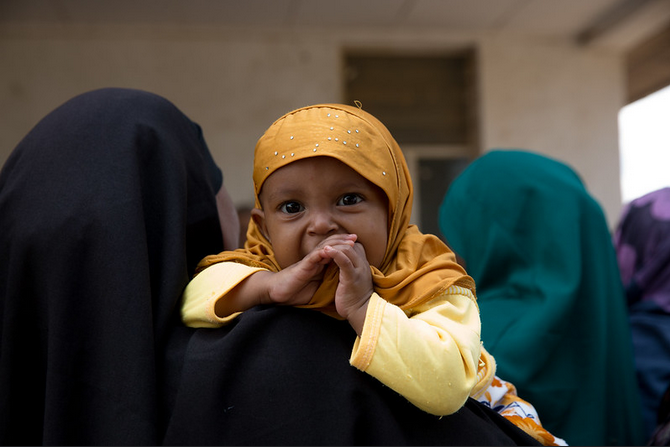
Human Vaccines & Immunotherapeutics, 19:1, 2190716, DOI: 10.1080/21645515.2023.2190716. Image caption/credit: Nasra Mohammed Sherif with her 7-month-old child, Siham Mohammed, after getting polio vaccine at Togwajale Health Center, Jigjiga, Somali Regional State. ©UNICEF Ethiopia/2019/Nahom Tesfaye via Flickr (CC BY-NC-ND 2.0)
- Log in to post comments