










































Understanding High-Priority Populations: Learning Brief 3
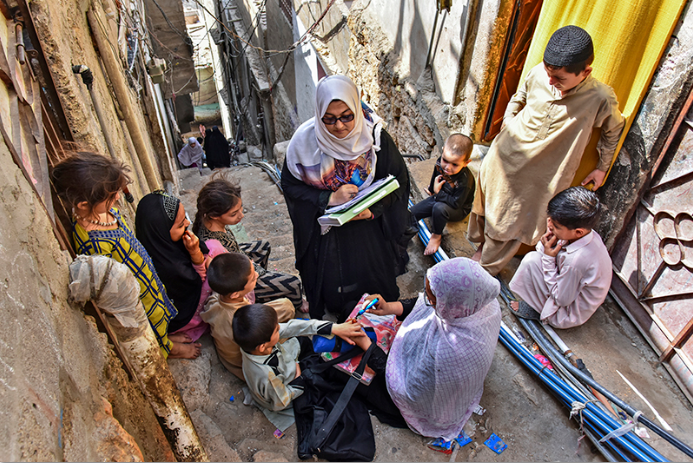
"The latter stages of polio eradication, where continued circulation of polio virus is often driven by small groups...require a deep understanding of local context."
These Learning Briefs (see Related Summaries, below) have been developed to capture priority communication challenges facing Pakistan's polio eradication programme. Each looks at a different topic and provides context (why the challenge is important), a description of the bottlenecks and gaps that need to be overcome, lessons from other relevant experiences, and an outline of programme plans to resolve each challenge. This Learning Brief focuses on high-priority populations.
Context
High-priority populations are defined by a range of indicators, such as the number of polio cases they experience, the number of refusals in their communities, the proportion of still-missed children following campaigns, and high rates of vaccine hesitancy or refusal. Examples of such groups identified in the National Emergency Action Plan (NEAP) for 2021 are Pashtun speakers and high-risk mobile populations.
The response to increasing vaccination amongst high-risk groups has so far focused largely on increasing the number of campaigns, aggressively identifying and following up on refusal families, engaging individuals deemed to be influential to promote vaccination and convince caregivers to vaccinate, creating enabling media environments through positive messaging on polio, and combatting rumours and misinformation through social media and interpersonal communication (IPC) tools for frontline workers (FLWs). Initiatives such as community-based vaccination (CBV) and challenge mapping have been introduced to try to embed polio campaigns within communities by ensuring that vaccinators and face-to-face communication are led by members of the communities themselves and that the challenges faced at local level are identified and incorporated into programme plans. And yet, eradication levels of vaccination remain elusive, and the programme now faces a major outbreak of wild poliovirus type 1 (WPV1), coupled with a large circulating vaccine-derived poliovirus type 2 (cVDPV2) outbreak, an increase in refusals, continued spread of rumours and misinformation, expansion of vaccine hesitancy, and growing animosity and distrust towards the polio programme.
In spite of the outbreaks and worrying trends, overall vaccination rates remain high, and refusals are low as a proportion of the population. But amongst some groups, distrust of the programme is growing, and polio vaccination is becoming viewed as an outside imposition rather than a social norm. Missed children are clustered in these communities at levels high enough to sustain transmission and to allow the virus to survive and exploit weaknesses in programme delivery. Given this context, the programme cannot continue to do what it has done in the past. Transformation will require a much better understanding of high-risk and therefore high-priority populations extending beyond identifying and vaccinating missed children to understanding why certain communities have lower vaccination rates, what their concerns and issues are, and what adjustments need to be made to close gaps in their immunity.
Bottlenecks and Gaps
The response so far has not been wrong so much as it has been incomplete. It has been less flexible than it needs to be and in many ways deaf to the local realities of high-risk populations. It has also tended towards a perception that more rounds and aggressive approaches to refusals will fill the gaps. In reality, this approach has led to increasing community frustration as their concerns go unheard, knocks on the door increase, and families are coerced into vaccination. It has also let the pressure of too many rounds too closely spaced together to undermine its ability to engage communities, listen to their concerns, develop community-appropriate responses and solutions, and adjust local practise accordingly. Old practises can become entrenched even when they consistently fail to achieve desired results. The transformation agenda of the 2021 NEAP needs to cement this break with past approaches. Adhering to plans to increase the space between rounds, protect community engagement capacity, and improve the ability to listen to and communicate with high-priority populations will be critical to stopping transmission.
Doing so will not be easy, given the ground that has been lost in community trust and acceptance of the programme. Regaining this ground will require not only the protection of community engagement capacities but their rebuilding after years of being relegated to a "nice to have extra" when there was time. It will also require filling a longstanding gap in the understanding of local community realities and perceptions through research, the co-creation of local solutions, and the identification and engagement of influencers who are trusted by marginalised and skeptical communities.
Lessons: India
A major focus of India's polio eradication endgame strategy was the engagement of underserved communities. The strategy focused on reaching out to "areas with families at high risk of wild poliovirus infection and with poor access to health, sanitation, and other basic services. Specifically, communities whose resentment against polio drops are largely an outcome of social exclusion, such as the paucity of support to their need for basic services". Many of these communities were Muslim, and the underserved strategy focused on identifying influential Muslim institutions (in this case, three universities) with significant networks of religious, academic, professional, and grassroots organisations that were willing to engage communities in dialogue towards support for, and participation in, polio vaccination. This initiative began almost 20 years ago but had an immediate and significant impact on increasing immunisation rates. Over time, this early initiative was built on through the establishment of the social mobilisation network (SMNet), which covered a more diverse set of high-risk groups such as mobile populations, hard-to-reach rural communities, and specific sectors such as brick kiln workers.
Key Lessons: The identification of a high-priority population such as Muslim communities in India was based on epidemiology, their attitudes towards polio, and an understanding of their social and economic context. Organisations were identified on the basis that they were genuinely trusted by these communities and had the networks and reach to create a large-scale and lasting impact on their relationship with the polio programme. As the Polio Eradication Initiative (PEI) moved closer to eradication, new high-risk populations were identified and specific initiatives were developed to reach these groups. Understanding each population and the specific socio-economic and cultural contexts they lived in was a critical element in developing programme approaches that worked.
Lessons: Culture and Behaviour - from the Global Polio Eradication Initiative
This research examines how the endgames for polio eradication in India, Nigeria, Pakistan, and Afghanistan were or still are blocked by community resistance among small groups. It points to evidence suggesting that while vaccinator performance and physical access related to security create blockages in the vaccination supply, unwillingness to be vaccinated by small groups of households and communities constitutes a principal demand-side barrier.
The question it poses is "why?" Culture has been treated as a dominant factor determining resistance to vaccination in the global programme. Resistance, often occurring in areas with substantial Muslim populations, has been associated with fear and rumour fuelled by ignorance and religious objection. Yet attitudes to the polio programme appear to vary substantially within small geographic areas. Rather than being a matter of common belief, public orientation appears to be shaped by a combination of religio-cultural and more localised socio-economic and political factors – in particular, the potentially aggressive nature of mass vaccination and the perceived under-supply of other development goods. Interpreting resistance to vaccination as essentially religio-cultural marginalises an understanding of resistance as the rational and strategic response by households and communities to systematic conditions of inequity and exclusion.
Key Lessons: The latter stages of polio eradication, where continued circulation of poliovirus is often driven by small groups defined by linguistic, religio-cultural, socio-economic, and geographic characteristics, require a deep understanding of local context. While there are supply-side blockages to vaccination that need to be considered, local resistance is a major demand-side barrier to eradication, and it should not be interpreted as an irrational response driven by religious obscurantism or ignorance. There are rational foundations to resistance that are often based in specific local realities that need to be understood, respected, and responded to if the programme is to reach eradication.
Ways Forward
A key finding of the June 2020 meeting of the Technical Advisory Group (TAG) was that the polio programme had "not achieved a 'breakthrough' in community engagement and trust, especially within Pashtun communities", which had suffered 81.2% of WPV cases over the previous 10 years and were the majority population in many core districts. In order to achieve this breakthrough, a new engagement strategy was developed that is embedded within a Pashtun-specific research, alliance, and problem identification/solving model rooted in local context. It focuses on local anthropological and economic research to facilitate: deeper programme understanding, alliance building with locally recognised decision-making institutions, capacity building of key supporters to understand and advocate for vaccination, participatory identification of concerns and blockages, co-creation of solutions, and more representative and community-mediated approaches to refusals and hesitancy.
The National Emergency Operations Centre (NEOC) in Pakistan subsequently established a working group (WG) to determine how best to carry forward a sustainable and evidence-based Priority Community Engagement Strategy (PCES) including Pashtun communities in 2021. A rapid desk review of key documentation between 2014 and 2020 was carried out to determine what was known about the issues affecting vaccination among priority populations in super high-risk union councils (SHRUCs) and to identify areas where further research is needed.
The findings identify a series of shared issues in South Khyber Pakhtunkhwa (KP), Peshawar, Quetta Block, and Karachi - e.g., annoyance with campaign frequency, hidden refusals such as e.g., annoyance with campaign frequency, hidden refusals such as claiming children were too sick to be vaccinated, demoralised and overworked FLWs, poor IPC skills of FLWs, mother's inability to accept vaccination at the door because husband forbade it, and mistrust of government/international actors, including local staff. Other issues were identified that were a priority in some but not all areas, such as preference for traditional medicine, low trust of programme influencers (e.g., religious support persons), widespread penetration of anti-polio vaccination propaganda, and coercive practices by local authorities.
A series of research briefs on key considerations for transformation were also prepared on areas critical to engaging high-priority populations, such as the use of FLWs as "problem solvers", fake finger marking (FFM) and false vaccination, the role of key provincial- and district-level actors in setting the right "tone", efforts to normalise polio within routine child health programming, divergent population-level concerns and needs ("priority 1" and "posh"), and good practices in integrated service delivery. Socio-cultural profiles were prepared for Bannu and Lakki Marwat in Southern KP to better understand the history, culture, and socio-economic realities of these Pashtun communities and their impact on polio vaccination.
These efforts provided the evidence base for the 2021 NEAP's four pillars for engaging priority communities:
- Conducting operational research to develop a deeper understanding of the specific challenges faced by the polio eradication effort in priority communities;
- Building strong, sustainable alliances between priority communities and the polio programme;
- Using integrated service delivery to create an enabling environment by meeting critical health needs of targeted communities; and
- Developing tailored operational delivery to address specific challenges.
An additional Area of Work (AoW) was subsequently incorporated into the NEAP 2021 to bring added focus and capacity to the PCES.
Sources
- India: UNICEF (2004). "When Every Child Counts - Engaging the Underserved Communities for Polio Eradication in Uttar Pradesh, India".
- SMNet: See, for instance, Anisur Rahman Siddique, Prem Singh, and Geetali Trivedi (August 2016). "Role of Social Mobilization (Network) in Polio Eradication in India." Indian Pediatrics 2016;53:S50-S56.
- Culture and Behaviour: Sebastian A.J. Taylor (March 2014). "Culture and Behaviour in Mass Health Interventions: Lessons from the Global Polio Eradication Initiative," Critical Public Health, 25:2, 192-204, DOI: 10.1080/09581596.2014.895799. Also on The CI Polio Network: https://www.comminit.com/polio/content/culture-and-behaviour-mass-health-interventions-lessons-global-polio-eradication-initiat
- Ways Forward: Priority Community Engagement Strategy Working Group (2020). "A Desk Review: What Do We Know? What Do We Need to Know More About?" Unpublished document, National Emergency Operations Centre for Polio Eradication.
- 81.2% of WPV cases over the previous 10 years: Pakistan National Emergency Action Plan 2021.
Image credit: Pakistan Polio Programme
- Log in to post comments