










































Insecurity, Polio Vaccination Rates, and Polio Incidence in Northwest Pakistan
St. Michael's Hospital (Verma, Razak); University of Toronto (Verma, Razak); University of Oxford (Verma); Brown University (Jimenez); independent scholar (Tangermann); Harvard T. H. Chan School of Public Health (Subramanian, Razak)
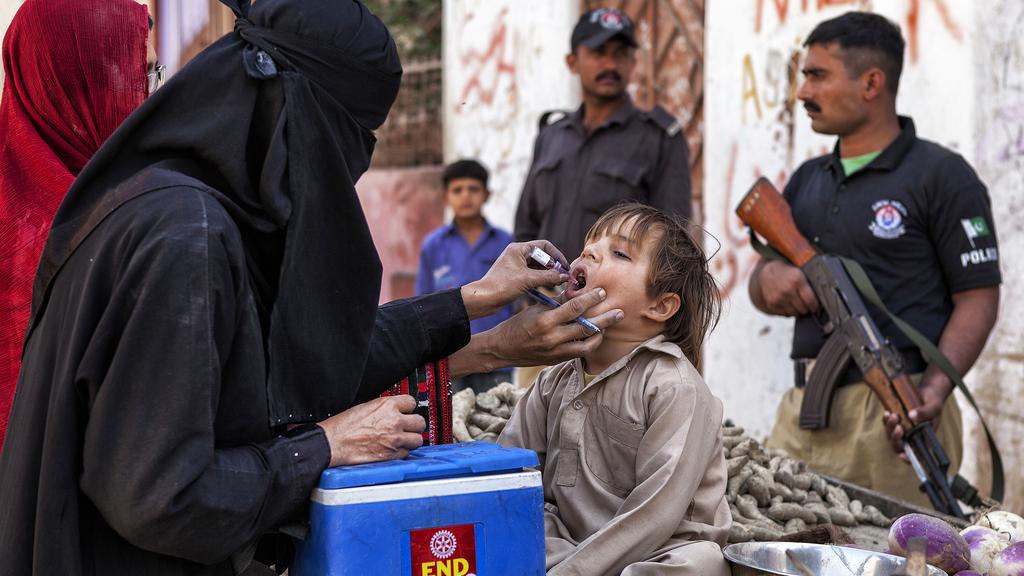
Pakistan is one of three countries in which endemic transmission of poliovirus has never been stopped. Insecurity is often cited as a barrier to eradicating polio; however, despite significant media coverage and commentary, there is little scientific evidence examining the relationships between insecurity, polio vaccinator access, vaccination rates, and polio case incidence. The purpose of this study was to examine the hypothesis that insecurity is associated with reduced polio vaccination and increased paralytic polio incidence in northwest Pakistan.
According to field reports cited here, insecurity can imperil vaccination campaigns by disrupting supply chains, exposing vaccinators to attack, restricting access to vulnerable populations, inducing mass migration, and limiting supervision and oversight. Furthermore, research has shown that caregivers in highly insecure areas in Pakistan and Nigeria have demonstrated limited awareness and negative attitudes toward polio vaccination. One example of the effect of insecurity on access to populations was the ban on polio vaccination in North and South Waziristan imposed by the local Taliban in 2012 and 2013. (The analyses carried out as part of the present study predate these highly publicised vaccination bans.)
The researchers analysed routinely collected health data from 32 districts of northwest Pakistan and constructed an index of insecurity based on journalistic reports of the monthly number of deaths and injuries resulting from conflict-related security incidents. The primary outcomes were the monthly incidence of paralytic polio cases within each district between 2007 and 2014 and the polio vaccination percentage from 666 district-level vaccination campaigns between 2007 and 2009, designed to reach approximately 5.7 million children. Multilevel Poisson regression controlling for time and district fixed effects was used to model the association between insecurity, vaccinator access, vaccination rates, and polio incidence.
The number of children inaccessible to vaccinators was 19.7% greater (95% confidence interval (CI): 19.2-20.2%), and vaccination rates were 5.3% lower (95% CI: 5.2-5.3%) in "high-insecurity" campaigns compared with "secure" campaigns. The unadjusted mean vaccination rate was 96.3% (standard deviation (SD) = 8.6) in secure campaigns and 88.3% (SD = 19.2) in high-insecurity campaigns. Polio incidence was 73.0% greater (95% CI: 30-131%) during high-insecurity months (unadjusted mean = 0.13 cases per million people, SD = 0.71) compared with secure months (unadjusted mean = 1.23 cases per million people, SD = 4.28). Thus, insecurity was associated with reduced vaccinator access, reduced polio vaccination, and increased polio incidence.
The researchers suggest that these findings offer several insights regarding the relationship between insecurity and vaccination campaigns:
- The mediation analysis carried out as part of the study demonstrated that the relationship between insecurity and reduced vaccination rates was driven by decreased vaccinator access. Notably, vaccinator access varies over time within districts. The Global Polio Eradication Initiative (GPEI) has a history of obtaining vaccinator access in insecure times - for example, by negotiating ceasefires in war. In Pakistan, rapid and unpredictable fluctuations in vaccinator access have necessitated novel approaches, such as conducting continuous vaccination programmes with local volunteers.
- Insecurity is not a static exposure and should be regarded as a longitudinal exposure that varies over time.
- The effects of even a low level of insecurity impair population immunity and result in ongoing poliovirus transmission. This emphasises the importance of maintaining access for vaccinators in insecure times.
- Vaccination rates were reduced in campaigns up to 12 months after security incidents. This may suggest that insecurity has more persistent consequences, such as erosion of trust, which can have longer-term effects on vaccination efforts. The study highlights the primary role of vaccinator access in mediating the relationship between insecurity and vaccination rates.
Although these findings are limited by difficulty with accurate assessments of population data by district, they support the conclusion that insecurity is an important obstacle to polio eradication.
Proceedings of the National Academy of Sciences of the United States of America; 115(7): 1593-98. doi: 10.1073/pnas.1711923115. Image credit: Asim Hafeez/The National
- Log in to post comments