










































Mapping Global Trends in Vaccine Confidence and Investigating Barriers to Vaccine Uptake: A Large-Scale Retrospective Temporal Modelling Study
The Vaccine Confidence Project, London School of Hygiene & Tropical Medicine, or LSHTM (de Figueiredo, Simas, Karafillakis, Paterson, Larson); Imperial College London (Figueiredo); University of Washington (Larson); University of Antwerp (Larson)
"It is vital with new and emerging disease threats such as the COVID-19 pandemic, that we regularly monitor public attitudes to quickly identify countries and groups with declining confidence, so we can help guide where we need to build trust to optimise uptake of new life-saving vaccines." - Professor Heidi Larson
Three previous systematic reviews conducted by the Vaccine Confidence Project (VCP) to measure and identify the key determinants of vaccine hesitancy have revealed that vaccine refusals and delays are contributing to an increasing number of outbreaks (e.g., of measles and polio) globally. To facilitate this research, in 2015, the VCP developed a Vaccine Confidence Index (VCI) survey tool to gauge individual perceptions on the safety, importance, effectiveness, and religious compatibility of vaccines. Using the VCI and led by the VCP, the present large-scale retrospective study provides multiyear global-level estimates of vaccine confidence from 2015 to 2019, exploring trends and determinants of uptake in 149 countries.
Specifically, the study analysed data from 290 nationally representative surveys of 284,381 adults in 149 countries collected from September 2015 to December 2019 - combining previously published data from nearly 250,000 survey responses with 50,000 additional interviews from 2019 - on the importance, efficacy, and safety of vaccines. The researchers used modelling to estimate trends in public perceptions and to assess the relationship between vaccine uptake in each country and demographics (i.e., age, sex, religious beliefs), socioeconomic factors (e.g., income, education), and source of trust (e.g., family, friends, health professionals).
In short, the study found that public confidence in vaccines varies widely around the world, with low but improving acceptance in some areas of Europe and growing wariness in countries experiencing political instability and religious extremism. Selected findings:
- In 2019, Iraq (95%), Liberia (93%), and Senegal (92%) had the highest proportion of respondents who agreed that it is important for children to be vaccinated, while Hong Kong (36%), Russia (34%), and Albania (26%) reported the lowest proportion strongly agreeing on the importance of vaccines.
- Vaccine confidence increased between 2015 and 2019 across all 3 elements of confidence (importance, efficacy, and safety) for France, India, Mexico, Poland, Romania, and Thailand.
- Meanwhile, vaccine confidence fell for all 3 elements of confidence in Indonesia, Pakistan, South Korea, and the Philippines. The researchers attribute the large decline in trust in the latter country (from 82% support for the safety of vaccines in 2015 to 58% in 2019) to adverse events in children associated with the dengue vaccine Dengvaxia in the past 3 years.
- Japan ranked among the countries with the lowest vaccine confidence in the world. The researchers suggest that this might be linked to the human papillomavirus (HPV) vaccine safety scares that started in 2013. The news of Japan suspending their proactive recommendation of the HPV vaccine has travelled globally through online media and social media networks.
- Strong anti-vaccine sentiment has grown in 6 politically unstable countries affected by religious extremism, including Afghanistan (from 2% in 2015 to 3% in 2019), Azerbaijan (2% to 17%), Indonesia (1% to 3%), Nigeria (1% to 2%), Pakistan (2% to 4%), and Serbia (4% to 7%).
- In South Korea, the anti-vaccine group ANAKI (a Korean acronym for "raising children without medication") and similar organisations have eroded trust in vaccines. Furthermore, declines in trust in vaccine safety (from 64% to 50%), importance (75% to 50%), and effectiveness (59% to 47%) were seen in Indonesia from 2015 to 2019, which the authors partially attribute to Muslim leaders' skepticism about the safety of the measles, mumps, and rubella (MMR) vaccine. The leaders issued a fatwa (religious order) forbidding the vaccine, claiming that it contains swine-derived ingredients (Muslims do not eat pork).
- Vaccine confidence in Europe ranged from just 19% in Lithuania to 66% in Finland in December 2019. And at least partially because of an anti-vaccine movement in Poland, vaccine confidence in that country fell from 64% in November 2018 to 53% in December 2019. But upticks have been noted in trust in vaccine safety in some areas of Europe, especially in Finland, France, Italy, Ireland, and the United Kingdom (UK).
Overall, the determinants most consistently associated with improved uptake were: high confidence in vaccines (66 countries); trusting healthcare workers more than family, friends, or other non-medical sources for medical and health advice (43 countries); higher levels of science education (35 countries); sex, with women more likely than men to report any child having at least one vaccine in 41 countries and men more likely than women in just one country (Chad); age (younger age groups associated with increased chances of uptake in 43 countries); and high information-seeking behaviour (18 countries).
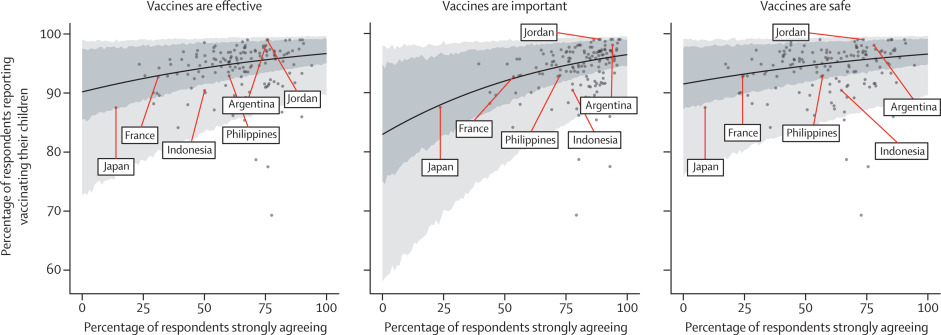
Data from the Wellcome Global Monitor (WGM) only, included in the analysis, reveal that countries with higher percentages of respondents strongly agreeing that vaccines are safe, important, and effective had higher percentages of respondents reporting they have had their children vaccinated. These effect sizes are small but significant. The analysis suggests that confidence in the importance of vaccines (rather than in their safety or effectiveness) is most strongly linked with vaccine uptake.
Reflecting on the findings, the researchers note, in part, that "Sentiments seeding doubt and distrust and the viral spread of misinformation are contributing to a landscape of uncertainty. Some actors have purposefully polarised vaccine debates, exploiting the doubting public and system weaknesses for political purposes, ...while waning vaccine confidence in other settings might be influenced by a wider environment of distrust in government and scientific elites."
One of the researchers, Clarissa Simas, explains that the findings "suggest that people do not necessarily dismiss the importance of vaccinating their children even if they have doubts about how safe vaccines are. The public seem to generally understand the value of vaccines, but the scientific and public health community needs to do much better at building public trust in the safety of vaccination, particularly with the hope of a COVID-19 vaccine." The researchers conclude that the results of this and other surveys can help focus public health efforts and resources in regions where they most need to build trust in vaccines.
Editor's note: In a complementary commentary, Daniel Salmon, PhD, and Matthew Dudley, PhD, of Johns Hopkins University argue: "Without substantial global investment in active vaccine safety surveillance, continuous monitoring of public perceptions, and development of rapid and flexible communication strategies, there is a risk of SARS-CoV-2 vaccines [in the context of the COVID-19 pandemic] never reaching their potential due to a continued inability to quickly and effectively respond to public vaccine safety concerns, real or otherwise." Click here for the commentary, titled "It Is Time to Get Serious about Vaccine Confidence", The Lancet, September 10 2020.
The Lancet https://doi.org/10.1016/S0140-6736(20)31558-0 - sourced from "Largest Global Vaccine Confidence Survey Reveals Hesitancy Hotspots", LSHTM, September 10 2020, and "Rising Vaccine Wariness in Some Nations Doesn't Bode Well for COVID Vaccines", by Mary Van Beusekom, Center for Infectious Disease Research and Policy (CIDRAP) News, Sepember 11 2020 - both accessed on September 14 2020.
- Log in to post comments